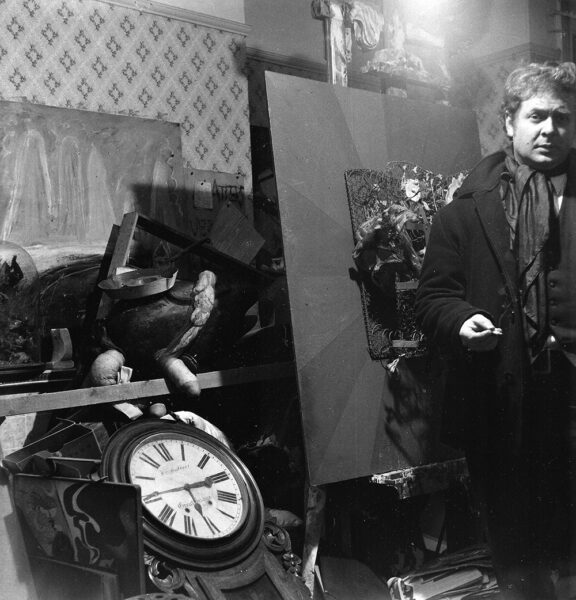
Project Sigma, which was the focus of much of Alexander Trocchi’s work from 1962-1977, was an attempt by Trocchi to establish an international network of counter cultural activism largely focused on socially based institutions perceived as limiting free expression such as the media, universities, and workplaces.
According to Beatbooks catalog, #92: “Project Sigma, which grew out of Alexander Trocchi’s involvement with the Situationist International (he was expelled by Guy Debord in 1963), was an ambitious attempt to establish an international network of countercultural activism focused on institutions Trocchi perceived as limiting free expression, including the media, universities and workplaces. The Sigma Portfolio, circulated on a subscription basis, was the concrete manifestation of his project, an invitation to recipients (artists, writers and intellectuals) to participate with their own contributions, as well as acting as an exemplar of underground self-dissemination.
“Several issues were mimeographed by Jeff Nuttall, sometimes assisted by Bob Cobbing, and Trocchi’s neighbour in the flat below him in Notting Hill, Marcus Field, helped in its organisation and collation (insofar as this was necessary, since some issues consisted of a single sheet).
“It has never been clear exactly how many issues were produced, though it’s been claimed there were as many as 39 (other reports suggest 37). It seems likely that several were never printed, possibly as many as 12 or 13…”
1a. THE MOVING TIMES, Sigma Portfolio , No. 1, edited by Alexander Trocchi and Jeff Nuttall
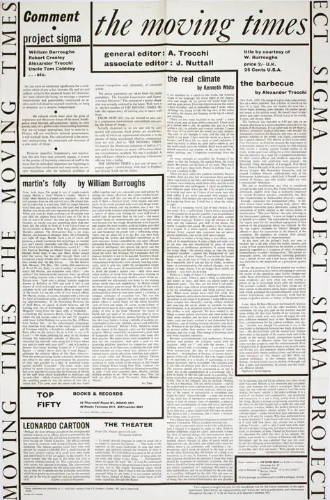 London: Project Sigma, 1964
First edition, broadsheet, 19” x 29”, letterpress printed at Villiers.
Contents: Alexander Trocchi – “The Barbecue”, Kenneth White – “The Real Climate”, William Burroughs – “Martin’s Folly”, Antonin Artaud – “The Theater”.
(See Maynard & Miles C109)
According to Beatbooks catalog #92, the title originated from the broadsheet edited by Burroughs which appeared in Jeff Nuttall’s My Own Mag, No. 6 earlier in 1964.
Note: The design of this, Trocchi’s first release under the banner of the Sigma Portfolio, was a large poster designed to resemble the front page of a newspaper and originally intended to be displayed in subway stations until the project became unfeasible.
1b. THE MOVING TIMES, Sigma Portfolio, No. 1, edited by Alexander Trocchi and Jeff Nuttall
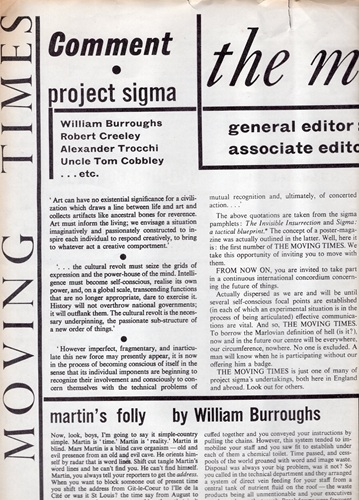 London: Project Sigma, 1964
First edition, second issue, double-sided folded broadsheet, 17” x 13.5”. Printed by Brian Pottle from the Stanhope Press.
(See Maynard & Miles C109)
2. Trocchi, Alexander. INVISIBLE INSURRECTION OF A MILLION MINDS, Sigma Portfolio, No. 2
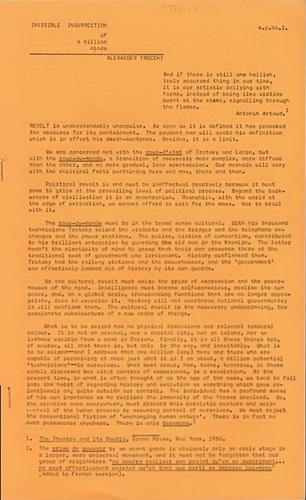 London: Project Sigma, 1964
First edition, side stapled, 8” x 13”, 8 pages, mimeograph printed.
Contents: Alexander Trocchi – “Invisible Insurrection of a Million Minds”. Originally published in the Saltire Review (1962) and subsequently printed in Internationale Situationniste (January 1963), as “Technique du Coup du Monde”
According to Beatbooks catalog #92, “The most comprehensive articulation of the Sigma experiment. In it, Trocchi argues ‘that a cultural revolution is already happening, that techniques can and are being invented for transcending conventional functions which are not appropriate to any imaginable future. Amongst other ideas is that of the “spontaneous university”, a fertile and experimental ambiance designed to equip men and women with those inner resources without which they will be unable to contend with LEISURE… a dominant fact of the future.'”
3. Trocchi, Alexander. SIGMA: A TACTICAL BLUEPRINT, Sigma Portfolio, No. 3
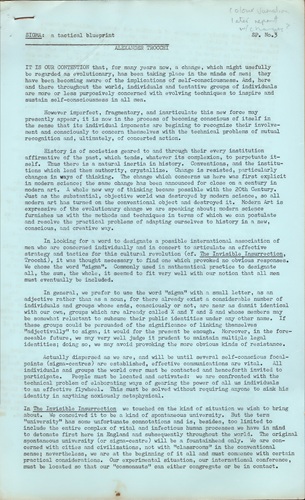 London: Project Sigma, 1964.
First edition, corner-stapled, 8” x 13”, 8 pages, mimeograph printed.
Contents: Alexander Trocchi – “Sigma: A Tactical Blueprint”
According to Beatbooks catalog #92, a development of the thesis outlined in the previous issue, including an explanation of the reasons behind the choice of the word ‘sigma’.
Note: an important early text outlining plans for the Sigma Project. The first separate edition, originally printed in City Lights Journal, No. 2.
Variant: edited to six pages and with different formatting.
4. [Trocchi, Alexander]. POTLATCH, Sigma Portfolio, No. 4
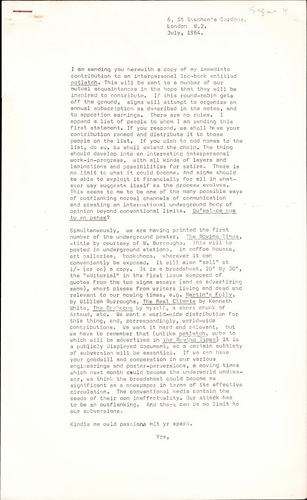 London: Project Sigma, July 1964
First edition, corner-stapled, 8” x 13”, 8 pages, mimeograph printed.
Contents: anonymous [Alexander Trocchi] – “Potlatch”
Note: an anonymous text, formatted as a letter to Feliks Topolski [according to Trocchi papers] asking for contributions for an interpersonal log-book for Sigma members. The text continues with an in-depth explanation of Situationist theory.
5. Trocchi, Alexander. SIGMA GENERAL INFORMATION SERVICE EXISTENTIAL CONSULTANTS LONDON PARIS NEW YORK, Sigma Portfolio, No. 5
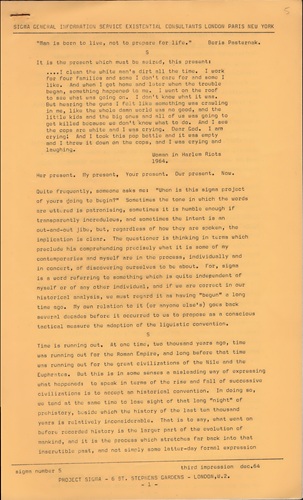 London: Project Sigma, 1964
First edition, corner-stapled, 8” x 13”, 8 pages, mimeograph printed.
Contents: anonymous [written by Trocchi] – “Sigma General Information Service Existential Consultants London Paris New York”
Note: essay discussing the Sigma Project in relation to theories from Burroughs, McClure, R.D. Laing, Wallace Berman, and others.
6. Laing, R.D. PRACTICE AND THEORY – THE PRESENT SITUATION, Sigma Portfolio, No. 6
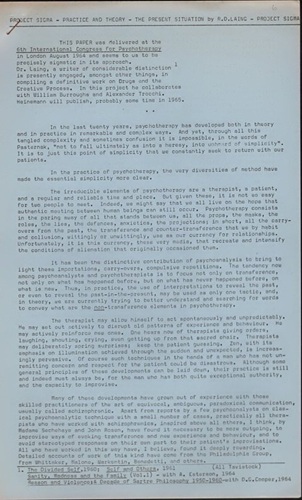 London: Project Sigma, 1964
First edition, corner-stapled, 8” x 13”, 6 pages, mimeograph printed.
Contents: R.D. Laing – “Practice and Theort – The Present Situation”
Note: a paper from the pseudo-scientist R.D. Laing, as presented at the 6th International Congress for Psychotherapy August 1964; a mixture of neo-Freudian text and an adaptation of existentialism.
7. Trocchi, Alexander. THE UNOFFICIAL POETRY CONFERENCE, EDINBURGH FESTIVAL, Sigma Portfolio, No. 7
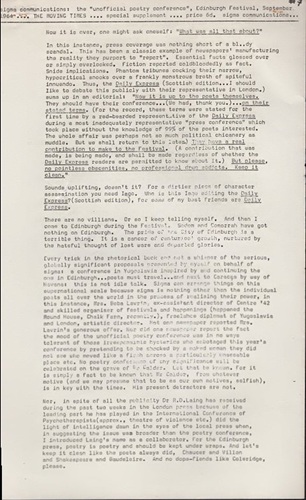 London/Edinburgh: Project Sigma/Moving Times, September 1964
First edition, single leaf, 8” x 13”, 2 pages, mimeograph printed.
Contributors include: Alexander Trocchi – “Unofficial Poetry Conference, Edinburgh Festival”
Note: Trocchi’s diatribe against the Daily Express’s reactionary reporting of the Unofficial Poetry Conference which took place during the Edinburgh Festival. Published as a special supplement to The Moving Times.
8. Howe, Eric. SHORT CONTRIBUTIONS, Sigma Portfolio, No. 8
9. McClure, Michael. POEMS, Sigma Portfolio, No. 9
[not issued, see Sigma Portofolio, No. 21]
10. LETTER FROM STAN BRAKHAGE TO ROBERT KELLY, Sigma Portfolio, No. 10
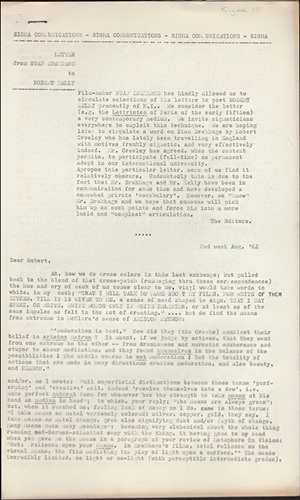 London: Project Sigma, 1964
First edition, corner-stapled, 8” x 13”, 4 pages, mimeograph printed.
Contents: Letter from Stan Brakhage to Robert Kelly
Note: contains the text of a letter from film-maker, Stan Brakkjage to Robert Kelly (the poet) where they discuss the function of art.
11. JOAN LITTLEWOOD PRESENTS, Sigma Portfolio, No. 11
 London: Project Sigma, 1964
First edition, folded broadsheet, 11.5” x 8.25” (folded), offset printed.
Together with a mimeograph sheet listing the Sigma Portfolio’s contents to date with a brief note to subscribers.
Note: produced in collaboration with the architect Cedric Price; also reproduces a text for Giant Space Mobile.
12. [Trocchi, Alexander]. THE SIGMA FOLIO – SUBSCRIPTION FORM, Sigma Portfolio, No. 12
 London: Project Sigma, 1964
First edition, single sheet, 8” x 13”, printed recto only, mimeograph printed.
Contents: Sigma Folio Subscription Form
Note: Includes a brief overview of the Sigma Portfolio which is “outflanking the traditional trap of publishing-house policy, and by means of which the reader gets it, so to speak ‘hot’ from the writer’s pen.”
13. Field, Marcus. SPECIAL SUPPLEMENT TO THE MOVING TIMES: WRITERS NIGHT AT BETTER BOOKS, Sigma Portfolio, No. 13
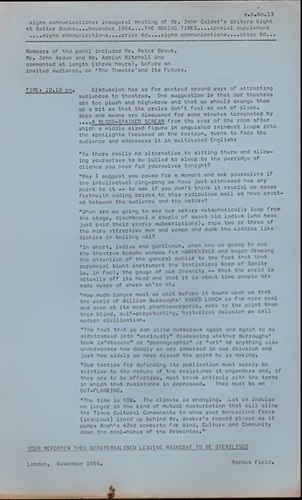 London: Project Sigma, 1964
First edition, single sheet, 8” x 13”, 2 pages, mimeograph printed. Published as a special supplement to The Moving Times.
Contents: Marcus Field – “The Theatre and Its Future”
Note: features Marcus Field’s contribution to the discussion at the “inaugural meeting of Mr. John Calder’s Writers Night at Better Books, November 1964”.
14. [Trocchi, Alexander]. PORTFOLIO LIST CUMULATIVE, Sigma Portfolio, No. 14
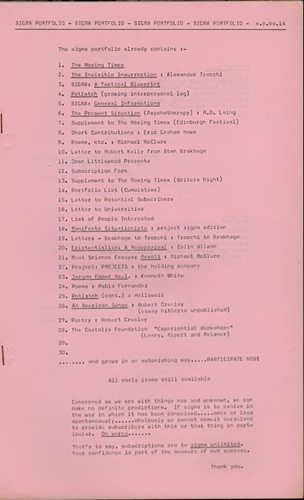 London: Project Sigma, 1964
First edition, single sheet, 8” x 13”, 2 pages, mimeograph printed.
Contents: a list of all available portfolios including projected numbers up to No. 28.
Note: attached to present copy are copies of Sigma portfolio Nos. 2, 5 and 12 (18 pages in total). Trocchi often sent bundles of all available issues to new subscribers.
15. [Trocchi, Alexander]. LETTER TO POTENTIAL SUBSCRIBERS / POTLACH, Sigma Portfolio, No. 15
 London: Project Sigma, 1964
First edition, single sheet, 8” x 13”, 4 pages, mimeograph printed.
Contents: a letter to potential subscribers [unattributed], a quote about Sigma from playwright John Arden and a list of 11 issues of the portfolio and a short unattributed text [by Alexander Trocchi?].
16. [Trocchi, Alexander]. LETTER TO UNIVERSITIES, Sigma Portfolio, No. 16
 London: Project Sigma, October 1964
First edition, single sheet, 8” x 13”, 2 pages, mimeograph printed.
Contents: effectively a cover letter explaining the Sigma project which was designed to be sent along with Sigma material for free.
17. [Trocchi, Alexander]. PUBLIC RELATIONS – SELECTIVE LIST OF INDIVIDUAL PARTICIPANTS, Sigma Portfolio, No. 17
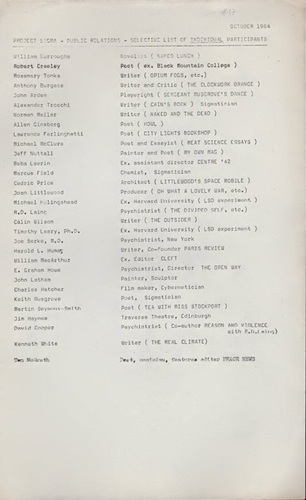 London: Project Sigma, October 1964
First edition, single sheet, 8” x 13”, 2 pages, mimeograph printed.
Contents: a list of individuals who were willing to be associated with the project including William Burroughs, Robert Creely, Anthony Burgess, John Arden, Norman Mailer, Allen Ginsberg, Lawrence Ferlinghetti, Michael McClure, Jeff Nuttall, Timothy Leary, and others.
18. [Trocchi, Alexander?]. MANIFESTO SITUATIONISTE: PROJECT SIGMA EDITION, Sigma Portfolio, No. 18
19. Brakhage, Stan and Alexander Trocchi. LETTER FROM STAN BAKHAGE TO TROCCHI, Sigma Portfolio, No. 19
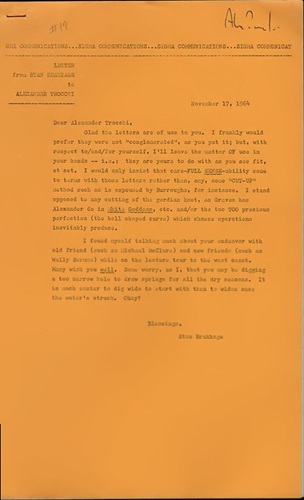 London: Project Sigma, November 1964
First edition, corner-stapled, 8” x 13”, 4 pages, mimeograph printed.
Contents: two letters, one from Stan Brakhage to Alexander Trocchi and the second is Trocchi’s reply.
20. Wilson, Colin. EXISTANTIALISM: A REAPPRAISAL, Sigma Portfolio, No. 20
21. ESSAY BY MICHAEL MCCLURE, Sigma Portfolio, No. 21
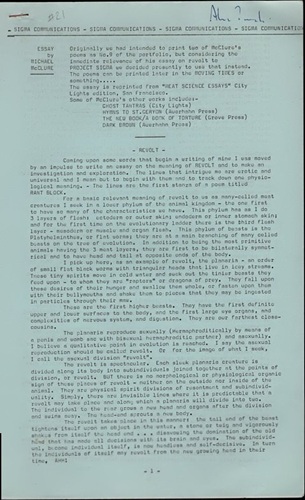 London: Project Sigma, 1964
First edition, corner-stapled, 8” x 13”, 8 pages, mimeograph printed.
Contents: Michael McClure – “Revolt” [published in Meat Science Essays (City Lights, 1963)]
Note: prefatory paragraph notes that this essay was published in lieu of Sigma Portofolio, No. 9 which was not issued.
22. [Trocchi, Alexander]. CULTURAL ENGINEERING PROJECTS: THE HOLDING COMPANY, Sigma Portfolio, No. 22
 London: Project Sigma, October 1964
First edition, single sheet, 8” x 13”, 2 pages, mimeograph printed.
Contents: Trocchi text proposing the formation of a limited company to “exploit the many and various cultural engineering projects” arising from Sigma.
23. White, Kenneth. JARGON PAPER NO 1, Sigma Portfolio, No. 23
24. Fernandez, Pablo. POEMS, Sigma Portfolio, No. 24
25. Hellawell, Neil. POTLATCH CONT., Sigma Portfolio, No. 25
26. Creeley, Robert. AN AMERICAN SENSE, Sigma Portfolio, No. 26
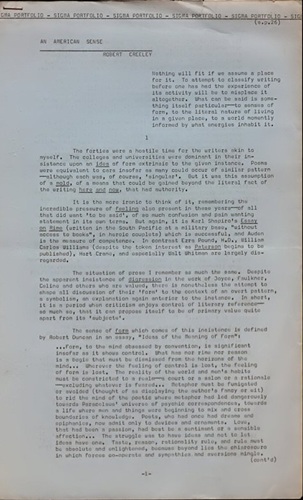 London: Project Sigma, 1964
First edition, corner-stapled, 8” x 13”, 6 pages, mimeograph printed.
Contents: Robert Creeley – “An American Sense”
27. Creeley, Robert. POETRY, Sigma Portfolio, No. 27
28. Castalio Foundation. EXPERIENTIAL WORKSHOPS, Sigma Portfolio, No. 28
29. [?]
30. Trocchi. Alexander. INTERNATIONAL COLLECTION, Sigma Portfolio, No. 30
31. Trocchi. Alexander. THE DECLINE AND FALL OF THE “SPECTACULAR” COMMODITY-ECONOMY, Sigma Portfolio, No. 31
32. Burroughs, William. THE INVISIBLE GENERATION, Sigma Portfolio, No. 32
—