Tag Archives: Jeff Nuttall

Project Sigma

Project Sigma, which was the focus of much of Alexander Trocchi’s work from 1962-1977, was an attempt by Trocchi to establish an international network of counter cultural activism largely focused on socially based institutions perceived as limiting free expression such as the media, universities, and workplaces.

According to Beatbooks catalog, #92: “Project Sigma, which grew out of Alexander Trocchi’s involvement with the Situationist International (he was expelled by Guy Debord in 1963), was an ambitious attempt to establish an international network of countercultural activism focused on institutions Trocchi perceived as limiting free expression, including the media, universities and workplaces. The Sigma Portfolio, circulated on a subscription basis, was the concrete manifestation of his project, an invitation to recipients (artists, writers and intellectuals) to participate with their own contributions, as well as acting as an exemplar of underground self-dissemination.

“Several issues were mimeographed by Jeff Nuttall, sometimes assisted by Bob Cobbing, and Trocchi’s neighbour in the flat below him in Notting Hill, Marcus Field, helped in its organisation and collation (insofar as this was necessary, since some issues consisted of a single sheet).

“It has never been clear exactly how many issues were produced, though it’s been claimed there were as many as 39 (other reports suggest 37). It seems likely that several were never printed, possibly as many as 12 or 13…”


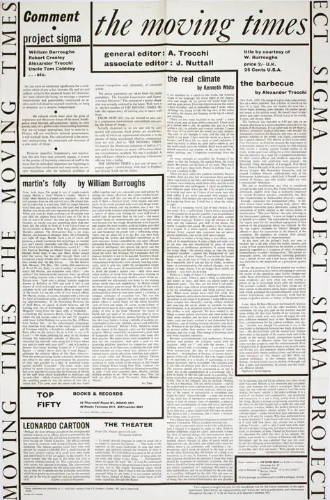
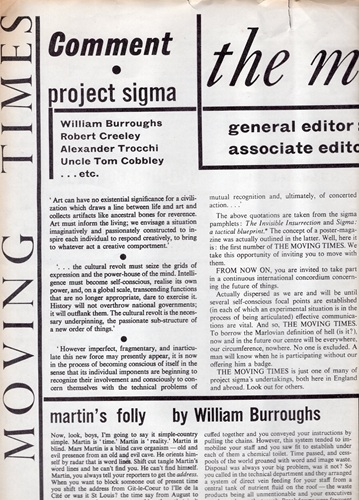
1a. THE MOVING TIMES, Sigma Portfolio , No. 1, edited by Alexander Trocchi and Jeff Nuttall
London: Project Sigma, 1964

First edition, broadsheet, 19” x 29”, letterpress printed at Villiers.

Contents: Alexander Trocchi – “The Barbecue”, Kenneth White – “The Real Climate”, William Burroughs – “Martin’s Folly”, Antonin Artaud – “The Theater”.
(See Maynard & Miles C109)

According to Beatbooks catalog #92, the title originated from the broadsheet edited by Burroughs which appeared in Jeff Nuttall’s My Own Mag, No. 6 earlier in 1964.

Note: The design of this, Trocchi’s first release under the banner of the Sigma Portfolio, was a large poster designed to resemble the front page of a newspaper and originally intended to be displayed in subway stations until the project became unfeasible.

1b. THE MOVING TIMES, Sigma Portfolio, No. 1, edited by Alexander Trocchi and Jeff Nuttall
London: Project Sigma, 1964

First edition, second issue, double-sided folded broadsheet, 17” x 13.5”. Printed by Brian Pottle from the Stanhope Press.
(See Maynard & Miles C109)

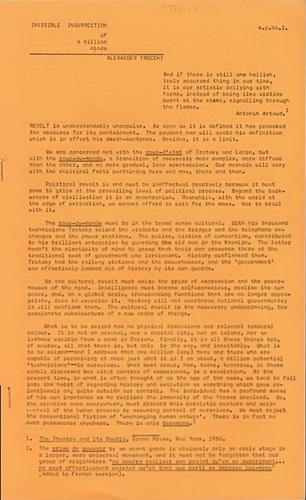
2. Trocchi, Alexander. INVISIBLE INSURRECTION OF A MILLION MINDS, Sigma Portfolio, No. 2
London: Project Sigma, 1964

First edition, side stapled, 8” x 13”, 8 pages, mimeograph printed.

Contents: Alexander Trocchi – “Invisible Insurrection of a Million Minds”. Originally published in the Saltire Review (1962) and subsequently printed in Internationale Situationniste (January 1963), as “Technique du Coup du Monde”

According to Beatbooks catalog #92, “The most comprehensive articulation of the Sigma experiment. In it, Trocchi argues ‘that a cultural revolution is already happening, that techniques can and are being invented for transcending conventional functions which are not appropriate to any imaginable future. Amongst other ideas is that of the “spontaneous university”, a fertile and experimental ambiance designed to equip men and women with those inner resources without which they will be unable to contend with LEISURE… a dominant fact of the future.'”

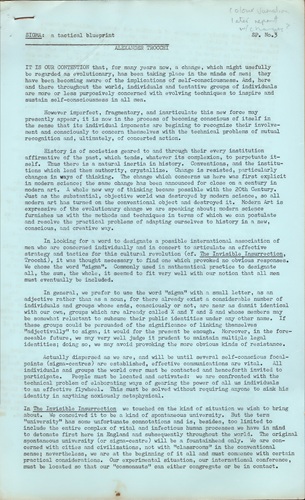
3. Trocchi, Alexander. SIGMA: A TACTICAL BLUEPRINT, Sigma Portfolio, No. 3
London: Project Sigma, 1964.

First edition, corner-stapled, 8” x 13”, 8 pages, mimeograph printed.

Contents: Alexander Trocchi – “Sigma: A Tactical Blueprint”

According to Beatbooks catalog #92, a development of the thesis outlined in the previous issue, including an explanation of the reasons behind the choice of the word ‘sigma’.

Note: an important early text outlining plans for the Sigma Project. The first separate edition, originally printed in City Lights Journal, No. 2.

Variant: edited to six pages and with different formatting.

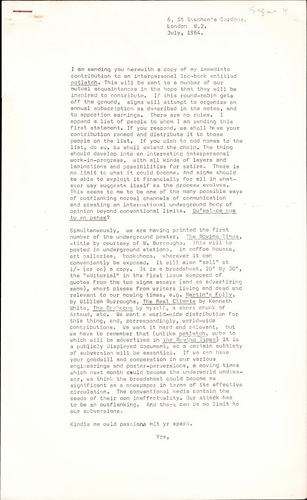
4. [Trocchi, Alexander]. POTLATCH, Sigma Portfolio, No. 4
London: Project Sigma, July 1964

First edition, corner-stapled, 8” x 13”, 8 pages, mimeograph printed.

Contents: anonymous [Alexander Trocchi] – “Potlatch”

Note: an anonymous text, formatted as a letter to Feliks Topolski [according to Trocchi papers] asking for contributions for an interpersonal log-book for Sigma members. The text continues with an in-depth explanation of Situationist theory.

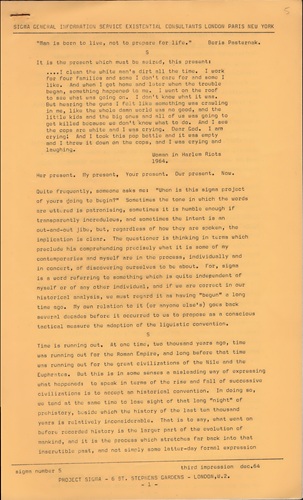
5. Trocchi, Alexander. SIGMA GENERAL INFORMATION SERVICE EXISTENTIAL CONSULTANTS LONDON PARIS NEW YORK, Sigma Portfolio, No. 5
London: Project Sigma, 1964

First edition, corner-stapled, 8” x 13”, 8 pages, mimeograph printed.

Contents: anonymous [written by Trocchi] – “Sigma General Information Service Existential Consultants London Paris New York”

Note: essay discussing the Sigma Project in relation to theories from Burroughs, McClure, R.D. Laing, Wallace Berman, and others.

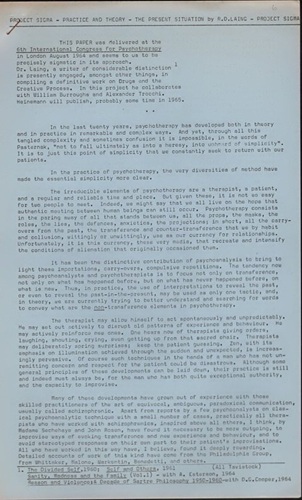
6. Laing, R.D. PRACTICE AND THEORY – THE PRESENT SITUATION, Sigma Portfolio, No. 6
London: Project Sigma, 1964

First edition, corner-stapled, 8” x 13”, 6 pages, mimeograph printed.

Contents: R.D. Laing – “Practice and Theort – The Present Situation”

Note: a paper from the pseudo-scientist R.D. Laing, as presented at the 6th International Congress for Psychotherapy August 1964; a mixture of neo-Freudian text and an adaptation of existentialism.

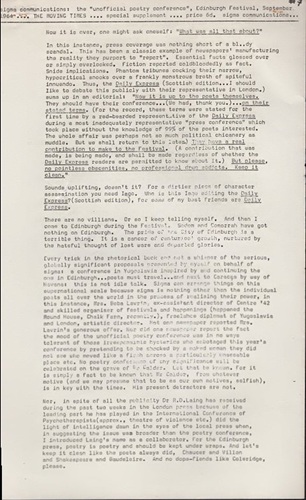
7. Trocchi, Alexander. THE UNOFFICIAL POETRY CONFERENCE, EDINBURGH FESTIVAL, Sigma Portfolio, No. 7
London/Edinburgh: Project Sigma/Moving Times, September 1964

First edition, single leaf, 8” x 13”, 2 pages, mimeograph printed.

Contributors include: Alexander Trocchi – “Unofficial Poetry Conference, Edinburgh Festival”

Note: Trocchi’s diatribe against the Daily Express’s reactionary reporting of the Unofficial Poetry Conference which took place during the Edinburgh Festival. Published as a special supplement to The Moving Times.

8. Howe, Eric. SHORT CONTRIBUTIONS, Sigma Portfolio, No. 8

9. McClure, Michael. POEMS, Sigma Portfolio, No. 9
[not issued, see Sigma Portofolio, No. 21]

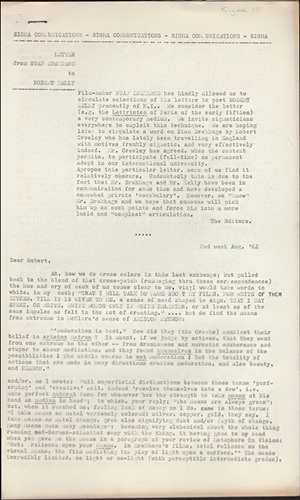
10. LETTER FROM STAN BRAKHAGE TO ROBERT KELLY, Sigma Portfolio, No. 10
London: Project Sigma, 1964

First edition, corner-stapled, 8” x 13”, 4 pages, mimeograph printed.

Contents: Letter from Stan Brakhage to Robert Kelly

Note: contains the text of a letter from film-maker, Stan Brakkjage to Robert Kelly (the poet) where they discuss the function of art.

11. JOAN LITTLEWOOD PRESENTS, Sigma Portfolio, No. 11
London: Project Sigma, 1964

First edition, folded broadsheet, 11.5” x 8.25” (folded), offset printed.

Together with a mimeograph sheet listing the Sigma Portfolio’s contents to date with a brief note to subscribers.

Note: produced in collaboration with the architect Cedric Price; also reproduces a text for Giant Space Mobile.

12. [Trocchi, Alexander]. THE SIGMA FOLIO – SUBSCRIPTION FORM, Sigma Portfolio, No. 12
London: Project Sigma, 1964

First edition, single sheet, 8” x 13”, printed recto only, mimeograph printed.

Contents: Sigma Folio Subscription Form

Note: Includes a brief overview of the Sigma Portfolio which is “outflanking the traditional trap of publishing-house policy, and by means of which the reader gets it, so to speak ‘hot’ from the writer’s pen.”

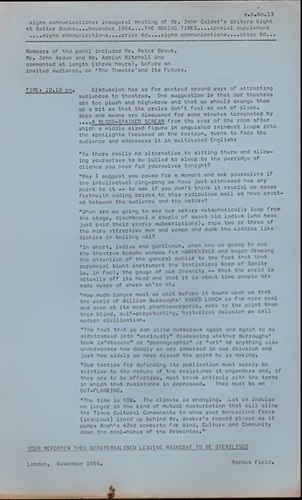
13. Field, Marcus. SPECIAL SUPPLEMENT TO THE MOVING TIMES: WRITERS NIGHT AT BETTER BOOKS, Sigma Portfolio, No. 13
London: Project Sigma, 1964

First edition, single sheet, 8” x 13”, 2 pages, mimeograph printed. Published as a special supplement to The Moving Times.

Contents: Marcus Field – “The Theatre and Its Future”

Note: features Marcus Field’s contribution to the discussion at the “inaugural meeting of Mr. John Calder’s Writers Night at Better Books, November 1964”.

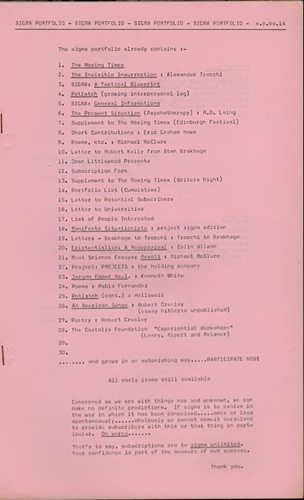
14. [Trocchi, Alexander]. PORTFOLIO LIST CUMULATIVE, Sigma Portfolio, No. 14
London: Project Sigma, 1964

First edition, single sheet, 8” x 13”, 2 pages, mimeograph printed.

Contents: a list of all available portfolios including projected numbers up to No. 28.

Note: attached to present copy are copies of Sigma portfolio Nos. 2, 5 and 12 (18 pages in total). Trocchi often sent bundles of all available issues to new subscribers.

15. [Trocchi, Alexander]. LETTER TO POTENTIAL SUBSCRIBERS / POTLACH, Sigma Portfolio, No. 15
London: Project Sigma, 1964

First edition, single sheet, 8” x 13”, 4 pages, mimeograph printed.

Contents: a letter to potential subscribers [unattributed], a quote about Sigma from playwright John Arden and a list of 11 issues of the portfolio and a short unattributed text [by Alexander Trocchi?].

16. [Trocchi, Alexander]. LETTER TO UNIVERSITIES, Sigma Portfolio, No. 16
London: Project Sigma, October 1964

First edition, single sheet, 8” x 13”, 2 pages, mimeograph printed.

Contents: effectively a cover letter explaining the Sigma project which was designed to be sent along with Sigma material for free.

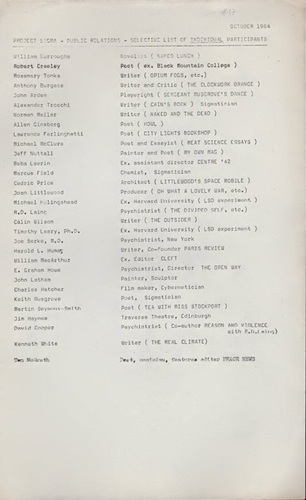
17. [Trocchi, Alexander]. PUBLIC RELATIONS – SELECTIVE LIST OF INDIVIDUAL PARTICIPANTS, Sigma Portfolio, No. 17
London: Project Sigma, October 1964

First edition, single sheet, 8” x 13”, 2 pages, mimeograph printed.

Contents: a list of individuals who were willing to be associated with the project including William Burroughs, Robert Creely, Anthony Burgess, John Arden, Norman Mailer, Allen Ginsberg, Lawrence Ferlinghetti, Michael McClure, Jeff Nuttall, Timothy Leary, and others.

18. [Trocchi, Alexander?]. MANIFESTO SITUATIONISTE: PROJECT SIGMA EDITION, Sigma Portfolio, No. 18

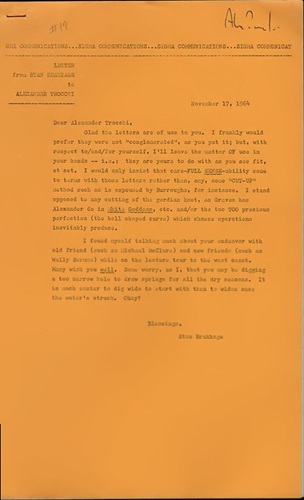
19. Brakhage, Stan and Alexander Trocchi. LETTER FROM STAN BAKHAGE TO TROCCHI, Sigma Portfolio, No. 19
London: Project Sigma, November 1964

First edition, corner-stapled, 8” x 13”, 4 pages, mimeograph printed.

Contents: two letters, one from Stan Brakhage to Alexander Trocchi and the second is Trocchi’s reply.

20. Wilson, Colin. EXISTANTIALISM: A REAPPRAISAL, Sigma Portfolio, No. 20

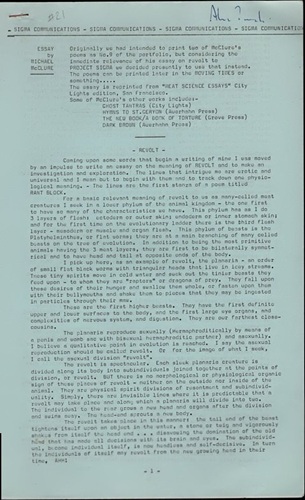
21. ESSAY BY MICHAEL MCCLURE, Sigma Portfolio, No. 21
London: Project Sigma, 1964

First edition, corner-stapled, 8” x 13”, 8 pages, mimeograph printed.

Contents: Michael McClure – “Revolt” [published in Meat Science Essays (City Lights, 1963)]

Note: prefatory paragraph notes that this essay was published in lieu of Sigma Portofolio, No. 9 which was not issued.

22. [Trocchi, Alexander]. CULTURAL ENGINEERING PROJECTS: THE HOLDING COMPANY, Sigma Portfolio, No. 22
London: Project Sigma, October 1964

First edition, single sheet, 8” x 13”, 2 pages, mimeograph printed.

Contents: Trocchi text proposing the formation of a limited company to “exploit the many and various cultural engineering projects” arising from Sigma.

23. White, Kenneth. JARGON PAPER NO 1, Sigma Portfolio, No. 23

24. Fernandez, Pablo. POEMS, Sigma Portfolio, No. 24

25. Hellawell, Neil. POTLATCH CONT., Sigma Portfolio, No. 25

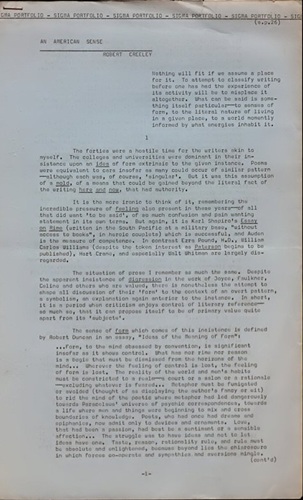
26. Creeley, Robert. AN AMERICAN SENSE, Sigma Portfolio, No. 26
London: Project Sigma, 1964

First edition, corner-stapled, 8” x 13”, 6 pages, mimeograph printed.

Contents: Robert Creeley – “An American Sense”

27. Creeley, Robert. POETRY, Sigma Portfolio, No. 27

28. Castalio Foundation. EXPERIENTIAL WORKSHOPS, Sigma Portfolio, No. 28

29. [?]

30. Trocchi. Alexander. INTERNATIONAL COLLECTION, Sigma Portfolio, No. 30

31. Trocchi. Alexander. THE DECLINE AND FALL OF THE “SPECTACULAR” COMMODITY-ECONOMY, Sigma Portfolio, No. 31

32. Burroughs, William. THE INVISIBLE GENERATION, Sigma Portfolio, No. 32

—

Bulletin from Nothing

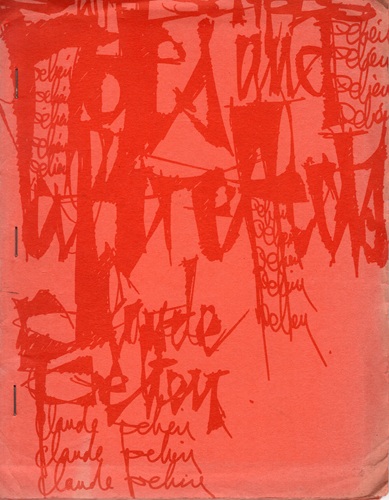
1. BULLETIN FROM NOTHING, No. 1, edited by Claude Pelieu and Mary Beach
San Francisco: Beach Books, 1965

First edition, saddle-stapled in printed and illustrated wrappers, 8.5” x 11”, 28 pages, offset-printed by Charles Plymell.

Contributors include: Claude Pelieu, Mary Beach, Jeff Nuttall, Antonin Artaud, William S. Burroughs, Charles Plymell, Roxie Powell, Benjamin Peret, Ed Sanders, Lawrence Ferlinghetti, Bob Kaufman, David Omer Bearden, Leland S. Meyerzove, Norman O. Mustill.

2. BULLETIN FROM NOTHING, No. 2, edited by Claude Pelieu and Mary Beach
San Francisco: Beach Books, 1965

First edition, gathered and folded but unbound in printed and illustrated wrappers, 8.5” x 11”, 28 pages, offset-printed by Charles Plymell.

Contributors include: William Burroughs, Roxie Powell, Claude Pelieu, Jeff Nuttall, Chano Pozo [aka Claude Pelieu], Jean-Jacques Lebel, Bob Kaufman, Charles Plymell, Norman O. Mustill, Ed Sanders, Peter Orlovsky, Mary Beach.

3. BULLETIN FROM NOTHING, No. 3, edited by Claude Pelieu and Mary Beach
San Francisco: Beach Books, Texts & Documents, 1969

First edition, single sheet of paper stock printed on both sides and folded to make 4 pages, 8.5” x 11” (folded). 

According to BeatBooks: “A collage of texts, drawings and photographs (including Allen Ginsberg, Taylor Mead and Viva, Joe Dallesandro, and Jean-Jacques Lebel), printed in purple and titled Bulletin From Nothing #3 along left edge (since this issue is more of a flyer publicising Beach Books than a magazine, the previous two issues from 1965 are usually considered to be the only two published). A statement printed along the right edge reads, ‘This Issue Is Dedicated to: Albert Fine, Wallace Berman, Janis Joplin, Harry Smith, the Motherfuckers, Super Love & Bradly-Martin…’”


Online resources:

—

Prison Clothes Press

>> return to JEFF NUTTALL main page >>

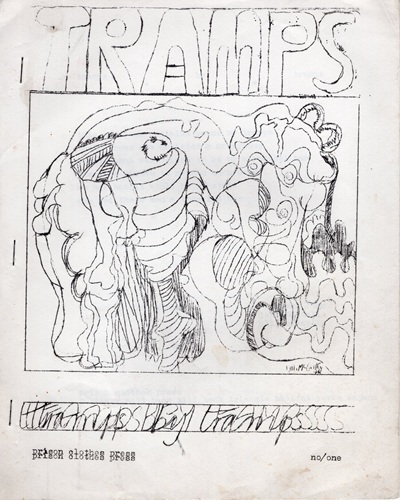
Prison Clothes Press was started in 1970 and edited by Ulli McCarthy and Jeff Nuttall. There were eight [or nine?] numbered publications issued by the press with the final one published in 1980.


1. TRAMPS BY TRAMPS, edited by Ulli McCarthy and Jeff Nuttall
Halifax: Prison Clothes Press, 1970

First edition, side-stapled in printed and illustrated cover, 8″ x 10″, 16 pages printed recto only, mimeograph-printed. Cover illustration by Ulli McCarthy. Published as Prison Clothes Press, No. 1.

from the Title Page: “this magazine contains poems by tramps / their poems are untitled & anonymous / these poems were given to us by a radical nun / she also wishes to remain anonymous / as her habbit would be at stake / she fed these men & they fed her”.

2. ZUSAMMEN, edited by Ulli McCarthy and Jeff Nuttall
n.p.: Prison Clothes Press, May 1971

3. ERIRE, by Ulli McCarthy
n.p.: Prison Clothes Press, 1971

First edition, side-stapled in printed cover, 8.25″ x 10″, 14 pages, mimeograph-printed. Illustrated by Jeff Nuttall. Published as Prison Clothes Press, No. 3.

4. Hemensley, Kris. THE SOFT POEMS
Kent: Prison Clothes Press & Joe DiMaggio Press, 1972

5. Kelly, Bernard J. LUTCHLOVE
n.p.: Prison Clothes Press, 1974

First edition, side-stapled in printed and illustrated cover, 8.25″ x 11.75″, 14 pages, mimeograph-printed (cover offset-printed). Cover illustration by Ulli McCarthy. Published as Prison Clothes Press, No. 5.

6. Fisher, Allen. 5 n.p.: Prison Clothes Press, Spring 1974

First edition, side-stapled in printed and illustrated cover, 8.25″ x 11.75″, 12 pages, mimeograph-printed (cover offset-printed). Cover illustration by Allen Fisher. Published as Prison Clothes Press, No. 6.

7. Dobbie, Mike. JUNK SCULPTURES
n.p.: Prison Clothes Press, 1975

First edition, side-stapled in printed and illustrated cover, 8.5″ x 12″, 26 pages, mimeograph-printed (cover offset-printed). Cover illustration by Jeff Nuttall. Published as Prison Clothes Press, No. 7.

8. Nations, Opal L. PREFACE XVIII
n.p.: Prison Clothes Press, 1976

9. Nuttall, Jeff. SCRAPYARD
n.p.: Prison Clothes Press, 1980

—

Rock Pot / Son of Rock Pot

>> return to JEFF NUTTALL main page >>

Rock Pot was a mimeograph magazine featuring poems by students in class 4C at Alder Secondary Modern School in East Finchley where Jeff Nuttall taught in 1964-1965. Nuttall anonymously edited the magazine. In 1965 Nuttall produced Son of Rock Pot with additional content from the students of class 4C.


1. ROCK POT, No.1, edited by Jeff Nuttall
East Finchley: privately printed, 1964

First edition, side-stapled in printed and illustrated cover, 8″ x 10.25″, 6 pages, printed mimeograph.

Contributors include: Keith Law, Peter O’Donnell, Christine Kilby, Fred Wonfor, M. Emeny, Pete Cotton , Douglas Tyldesley, John Sterry, Sonia Tofton, Gina Larkins, Jennifer Johns.

2. ROCK POT, No.1, edited by Jeff Nuttall
East Finchley: privately printed, 1964

First edition, saddle- stapled in printed and illustrated wrappers, 6.75″ x 8″, 4 pages, printed mimeograph.

Contributors include: Christine Kilby, Keith Law, Gina Larkins, Peter Cotton, Fred Wonfer, Stephen Saunders.

3. ROCK POT, No.3, edited by Jeff Nuttall
East Finchley: privately printed, 1964

First edition, side- stapled in printed and illustrated cover, 8″ x 10″, 4 pages, printed mimeograph.

Contributors include: Christine Kilby, Peter Cotton, Stephen Saunders, Fred Wonfer, Douglas Tyldesley, Melvin Emeny, Gina Larkins, Jennifer Johns.

4. ROCK POT, No.4, edited by Jeff Nuttall
East Finchley: privately printed, 1964

First edition, corner- stapled in printed and illustrated cover, 8″ x 10″, 6 pages, printed mimeograph.

Contributors include: Dougie Tyldesley, Sonia Tofton, Fred Wonfer, Gina Larkins, Keith Law, Stephen Saunders, Jennifer Johns, Sonia Tofton, John Sterry.

5. SON OF ROCK POT, edited by Jeff Nuttall
East Finchley: privately printed, 1965

First edition, corner- stapled in printed and illustrated cover, 8″ x 10″, 6 pages, printed mimeograph.

Contributors include: Terry Allsop, Robert Burgess, Keith Wright, Helen Tyler, Barry Howard, Stephen Borg, William Clarke, Stephen Dummer, Robert Currell, Darylin Foskett, Robin Warren, Trevor Pratt,

from the Editor’s Note: “More than ten years ago the famous American poet Allen Ginsberg wrote a long poem about his generation called ‘Howl.’ Less than ten weeks ago the pop group called the Who made a record about their generation (which is, more or less, your generation) which consists largely of stuttering. In these poems 4C have borrowed the forms and techniques of Allen Ginsberg to put words where the Who could only stutter.”

—

George: Son of My Own Mag

>> return to JEFF NUTTALL main page >>

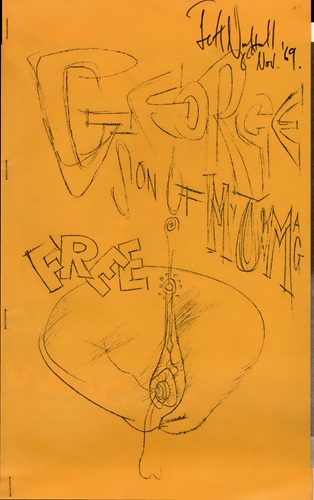
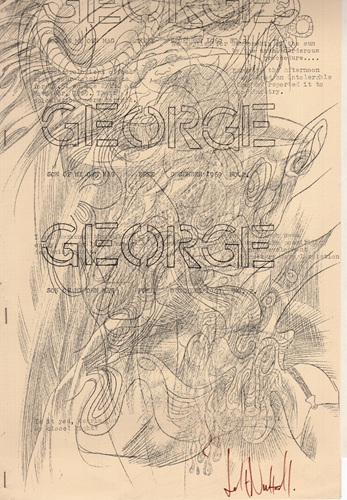
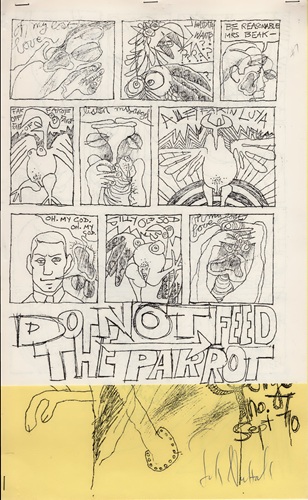
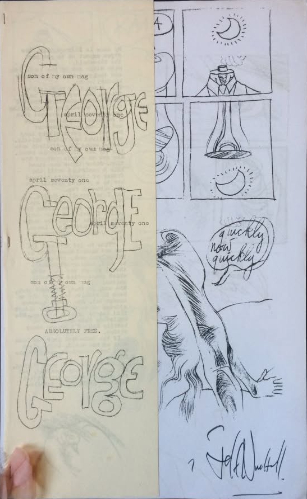
George: Son of My Own Mag was  edited and published in London by Jeff Nuttall between November 1969 and April 1971. It followed Nuttall’s earlier influential counterculture mimeograph periodical My Own Mag, which ran from 1963 to 1966.  A total of 8 issues were produced with illusttrative content similar to My Own Mag.


1. George: Son of My Own Mag, No. 1, edited by Jeff Nuttall
n.p.: privately printed, November 1969

First edition, side-stapled in printed and illustrated cover, 8” x 13”, 12 pages with insert from adult magazine, mimeograph printed. Illustrated by Jeff Nuttall.

Contributors: Jeff Nuttall.

2. George: Son of My Own Mag, No. 2, edited by Jeff Nuttall
n.p.: privately printed, December 1969

First edition, side-stapled in printed and illustrated cover, 8” x 13”, 10 pages with insert of a mimeograph stencil used for the cover, mimeograph printed. Illustrated by Jeff Nuttall.

Contributors: Jeff Nuttall.

3. George: Son of My Own Mag, No. 3, edited by Jeff Nuttall
n.p.: privately printed, January 1970

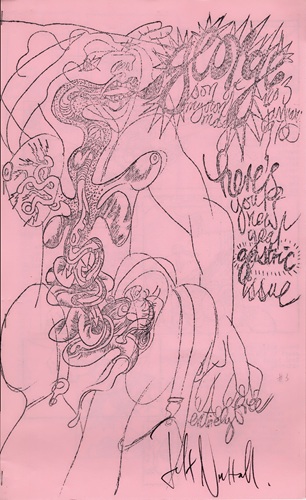
First edition, side-stapled in printed and illustrated cover, 8” x 13”, 8 pages, mimeograph printed. Illustrated by Jeff Nuttall. Published as the “New Year gastric issue”.

Contributors: Jeff Nuttall.

4. George: Son of My Own Mag, No. 4, edited by Jeff Nuttall
n.p.: privately printed, n.d.

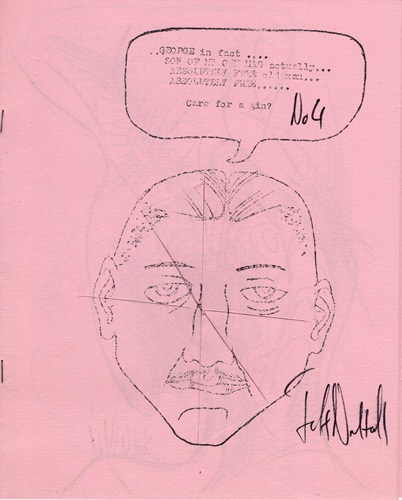
First edition, side-stapled in printed and illustrated cover, 6.5” x 8”, 12 pages each cut through with some folded exposing drawings on following pages, mimeograph printed. Illustrated by Jeff Nuttall.

Contributors: Jeff Nuttall.

5. George: Son of My Own Mag, No. 5, edited by Jeff Nuttall
n.p.: privately printed, Easter 1970

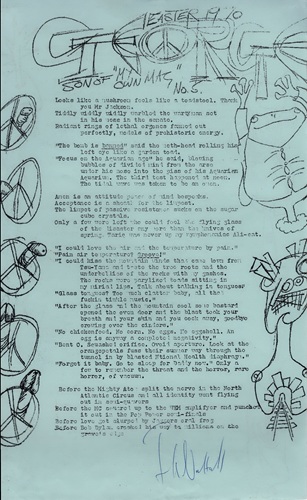
First edition, single printed and illustrated sheet, 8” x 13”, 2 pages, mimeograph printed. Illustrated by Jeff Nuttall.

Contributors: Jeff Nuttall.

6. George: Son of My Own Mag, No. 6, edited by Jeff Nuttall
n.p.: privately printed, n.d.

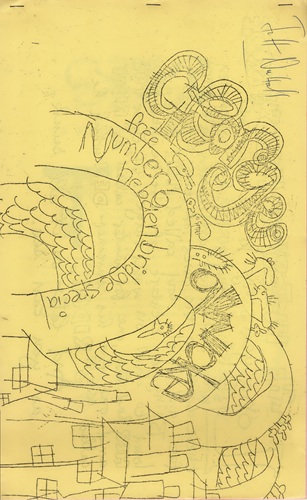
First edition, side-stapled in printed and illustrated cover, 13” x 8”, 12 pages with insert from childrens christmas book, mimeograph printed. Illustrated by Jeff Nuttall. Published as the “Hebden Bridge Special”.

Contributors: Jeff Nuttall.

7. George: Son of My Own Mag, No. 7, edited by Jeff Nuttall
n.p.: privately printed, September 1970

First edition, top and side-stapled in printed and illustrated cover, 8” x 13”, 8 pages, mimeograph printed. Illustrated by Jeff Nuttall.

Contributors: Jeff Nuttall.

8. George: Son of My Own Mag, No. 8, edited by Jeff Nuttall
n.p.: privately printed, April 1971

First edition, side-stapled in printed and illustrated cover, 8” x 13”, colored ribbon attached to lower corner, mimeograph printed. Illustrated by Jeff Nuttall.

Contributors: Jeff Nuttall.


References consulted:

Jeff Nuttall – Books

>> return to JEFF NUTTALL main page >>

SECTION A:
This index includes books and chabooks published from 1964 to the early 2000s.


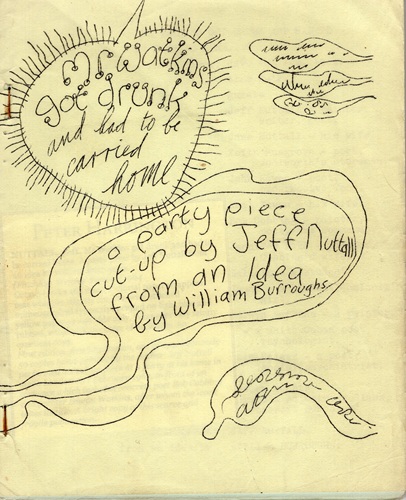
1. Nuttall, Jeff. MR. WATKINS GOT DRUNK AND HAD TO BE CARRIED HOME
n.p.: privately printed, February 1964

First edition, side-stapled in illustrated and printed wrappers, 6.75” x 8”, 92 pages, 50 copies, cover illustration by Nuttall, mimeograph printed.

Note: The book’s title refers to Welsh artist Islwyn Watkins, a friend of Nuttall’s who described the origin of the work in an interview with David Moore on Reality Studio: “The context of that was Jeff and his wife Jane decided to hold a party at their house in Salisbury Road and invited a range of people — Group H members, Writers’ Forum members and other people — to attend the party but they had to bring with them a text which described the party and what went on in the party so that it was a forecast of what happened. As well as this he tape-recorded the actual party and the idea was that all these accounts would be cut up and reassembled to produce an analogy to the party but not a logical description of it. As well as taking my forecast of the events of the party along to the house that night I took with me four or five accounts written by pupils I was involved with at the time in school who were remedial education pupils and they, in fact, wrote accounts of the party featuring, of course, me, and one of those accounts was Mr Watkins Got Drunk & Had to be Carried Home. It didn’t actually happen.”

2. Nuttall, Jeff. POEMS I WANT TO FORGET
London: Turret Books, 1965

3. Nuttall, Jeff. PIECES OF POETRY
London: Writers Forum, February 1966

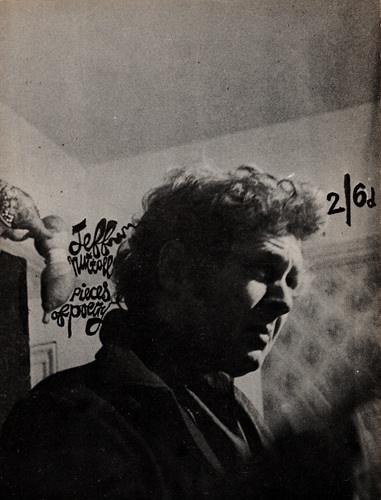
First edition, side-stapled and bound in photo-illustrated and printed wrappers, 6.75” x 9”, 36 pages, 500 copies (12 copies numbered and signed by the author), offset printed at the Coptic Press. Cover photo of Nuttall by Dave Trace. Published as Writers Forum Poets, No. 17. (Mayer 23)

4. Nuttall, Jeff. COME BACK SWEET PRINCE: A NOVELETTE
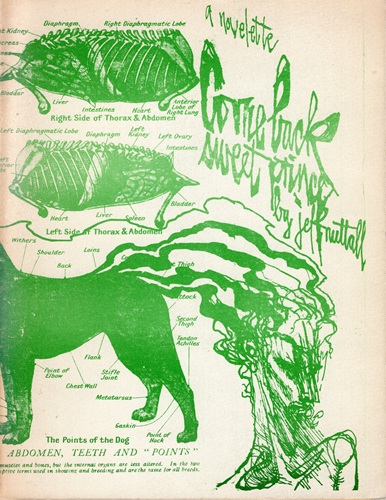
London: Writers Forum, December 1966

First edition, saddle-stapled in illustrated and printed wrappers, 6.5” x 8.5”, 40 pages, limitation not stated (12 copies numbered and signed by the author), offset printed by Cuddon’s Cosmopolitan Review. Published as Writers Forum Poets, No. 21. (Mayer 31)

5. Nuttall, Jeff. THE CASE OF ISABEL AND THE BLEEDING FOETUS
London: Turret Books, 1967

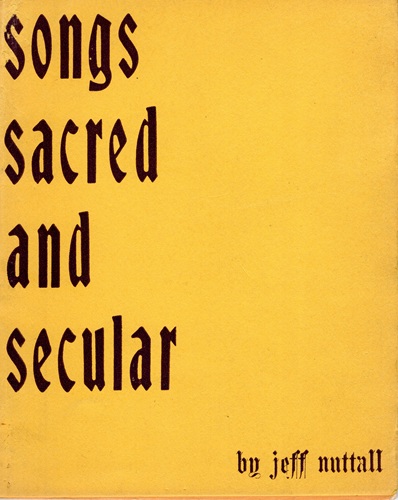
6. Nuttall, Jeff. SONGS SACRED AND SECULAR
n.p.: self published, 1967

First edition, saddle-stapled in printed wrappers, 6.5” x 8”, 40 pages, errata slip tipped in, mimeograph printed, covers printed letterpress.

From the title page: “Certain poems in this book have appeared previously in Ambit, the Transatlantic Review, My Own Mag and Writers’ Forum Poets.”

7. Nuttall, Jeff. OSCAR CHRIST AND THE IMMACULATE CONCEPTION
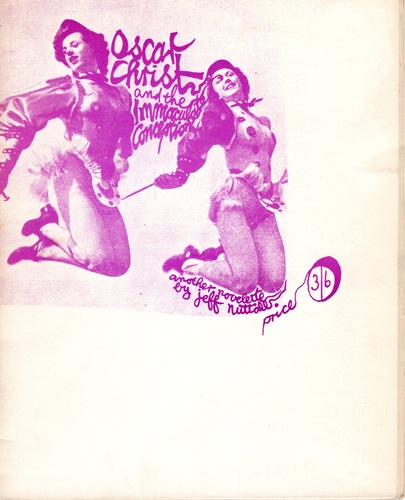
London: Writers Forum, September 1968

First edition, saddle-stapled in illustrated and printed wrappers, 6.5” x 8”, 28 pages, offset printed, cover design by Nuttall. Published as Writers Forum Poets, No. 23. (Mayer 38)

Note: Second printing in August 1970.

8. Nuttall, Jeff. MR. WATKINS GOT DRUNK AND HAD TO BE CARRIED HOME
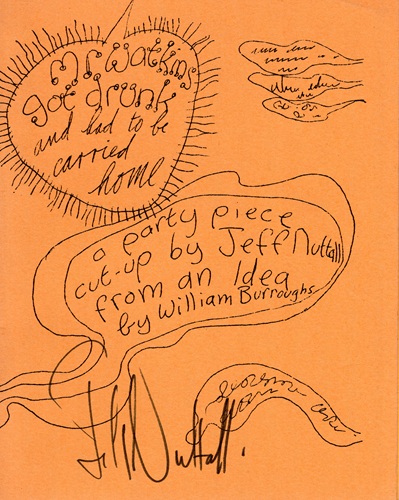
London: Writers Forum, September 1968

Second printing, saddle-stapled in illustrated and printed wrappers, 6.5” x 8”, 48 pages, 500 copies (12 copies numbered and signed by the author), cover illustration by Nuttall. Published as Writers Forum Poets, No. 24. (Mayer 39)

From the colophon: “This publication assisted by a financial grant from the Arts Council of Great Britain is a facsimile of the original hors-commerce edition.”

9. Nuttall, Jeff. JOURNALS
Brighton: Unicorn, 1968

10. Nuttall, Jeff. BOMB CULTURE
London: MacGibbon & Kee, 1968
First edition, hardcover in paper-bound boards with gilt-stamped spine in printed and illustrated dust jacket, 5.25” x 9”, 262 pages including index.

11. Nuttall, Jeff. LOVE POEMS
Brighton: Unicorn Books, 1969

12. Nuttall, Jeff. PIG
London: Fulcrum Press, 1969

13. Nuttall, Jeff. POEMS 1962-1969
London: Fulcrum Press, 1970

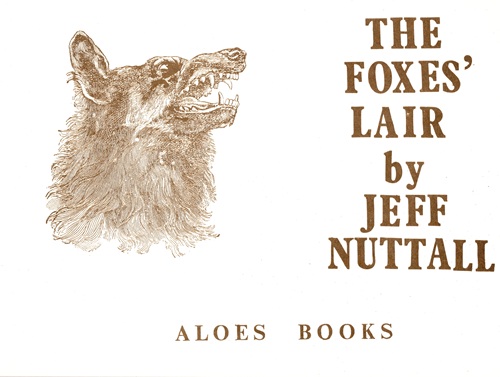
14. Nuttall, Jeff. FOXES’ LAIR
London: Aloes Books, 1972

First edition, saddle-stapled in printed and illustrated wrappers in printed envelope, 8.25” x 6.25”, 32 pages, 500 copies (25 lettered copies signed by the author), offset printed. Illustrated by Nuttall.

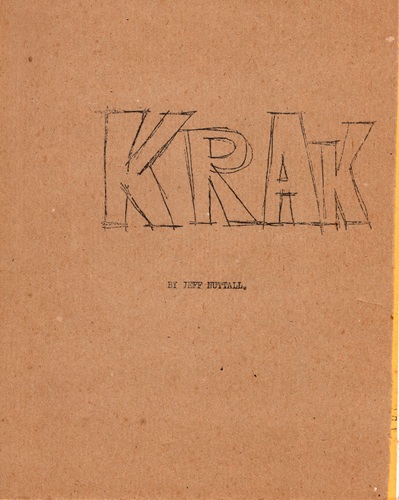
15. Nuttall, Jeff. KRAK
Bradford: Jack Press, January 1975

First edition, saddle-stapled in printed and illustrated wrappers, 6.5” x 8”, 24 pages, mimeograph printed. Illustrated by Nuttall.


16. Nuttall, Jeff. THE HOUSE PARTY
Toronto: Basilike, 1975

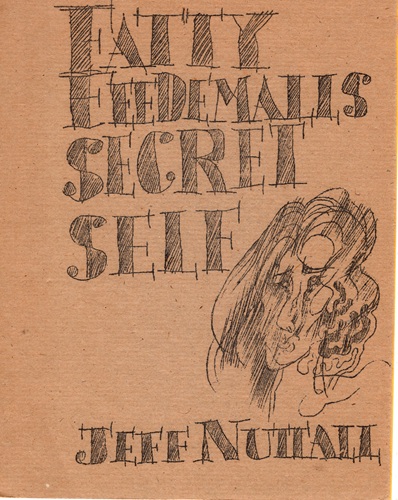
17. Nuttall, Jeff. FATTY FEEDEMALL’S SECRET SELF: A DREAM
Bradford: Jack Press, 1975

First edition, saddle-stapled in printed and illustrated wrappers, 6.5” x 8”, 24 pages, mimeograph printed. Cover and title page illustrations by Nuttall.

18. Nuttall, Jeff. SNIPES SPINSTER
London: Calder & Boyers, 1975
First edition, hardcover in cloth-bound boards with gilt-stamped spine in printed and illustrated dust-jacket, 5.5” x 8”, 120 pages including notes. Jacket design by Nuttall.

From the jacket: “This book, says the author, is an attempt to kiss goodbye to Bomb Culture as a book by which to be identified.”

19. Nuttall, Jeff. MAN NOT MAN
Carmarthen: Unicorn Books, 1975

20. Nuttall, Jeff. THE ANATOMY OF MY FATHER’S CORPSE
Toronto: Basilike, 1975

21. Nuttall, Jeff. SUN BARBS
London: Poet & Peasant Books, 1976

22. Nuttall, Jeff. OBJECTS
London: Trigram Press, 1976

23. Nuttall, Jeff. THE GOLD HOLE
London: Quartet Books, 1978

Jeff Nuttall

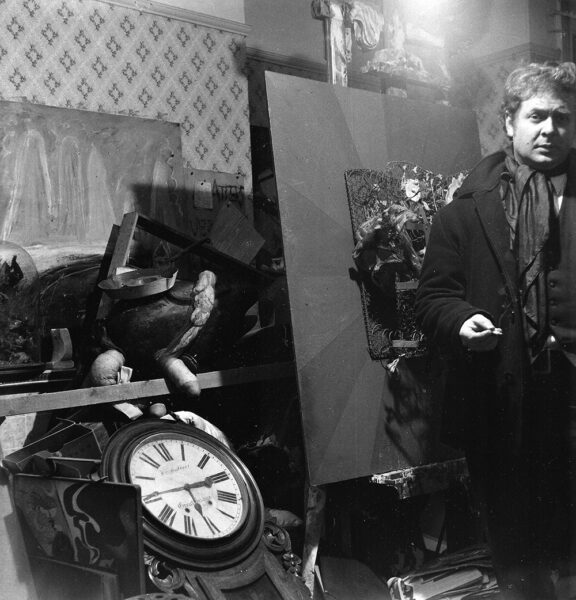
Jeff Nuttall, Todmorden, photograph © David Trace

Jeff Nuttall was a prolific artist and poet but he was also a jazz musician, critic, social commentator, theatrical innovator and influential teacher. In an obituary, the poet Michael Horovitz fittingly described him as ‘a catalyst, perpetrator and champion of rebellion and experiment in the arts and society’. Certainly, Nuttall worked at the margins, creating artworks, performances and writings which challenged moral and political orthodoxies and continually tested the boundaries of social acceptability and public taste. Whilst Nuttall’s creative output – in all its forms – relentlessly confronted authoritarianism, it fundamentally celebrated the nature of what it is to be human with a wonder and rawness which is sometimes comic, sometimes disturbing.


Born in Clitheroe, Nuttall spent his youth in Herefordshire’s Welsh borders, but returned north to live in Lancashire and Yorkshire for a number of periods throughout his adult life. After leaving art college, his early work demonstrates a preoccupation with the human figure but his involvement in the late 1950s London jazz scene and the early activities of the Campaign for Nuclear Disarmament provided new subjects for exploration through writings and drawings.

Nuttall soon became a pivotal figure in Sixties’ British ‘counter-culture’. He played a key role within the international ‘underground’ press and literary scene, exchanging writings and ideas with fellow thinkers in the United States and Europe – such as William Burroughs, Carl Weissner, Alexander Trocchi, Bob Cobbing and Dom Sylvester Houedard – initiating small journals such as the anarchic cut-up My Own Mag or collaborating on various publishing projects. Much of this is chronicled in Bomb Culture, his semi-autobiographical account published in 1968.

In the Sixties, Nuttall also started working with found objects and soft materials – often using stockings and kapok – to create a series of assemblages which resembled dishevelled or distorted human body parts. Sometimes, these objects would be left in luggage lockers to be discovered later at random. Occasionally, they formed part of a performance, environment or “happening”, an informal, often spontaneous, transient multi-media event which usually involved audience participation. His contribution to the early development of happenings in Britain was particularly important through collaborations and connections with a coterie of artists involved with Group H, the Drury Lane Arts Lab and sTigma.

Happenings merged into the burgeoning field of ‘performance art’ when, in 1966, Nuttall founded the People Show, an eclectic group of artists and performers which took their live acts and improvisational interventions onto the streets, into telephone boxes and public toilets. Since then, attracting a diverse range of artists, musicians and practitioners, the People Show has maintained Nuttall’s legacy with its commitment to the production of experimental multi-disciplinary performances.

In the 1980s, with spells in Australia, Portugal, London, Lancashire and then shifting to the rural borders of Wales, Nuttall returned to painting – producing a series of expressionistic landscapes and reliefs which marry the eroticism of his earlier drawings with a heightened awareness of the fecundity of nature.

From the 1960s through to the mid-1980s, Nuttall was an inspirational teacher, first at Leeds Polytechnic and then as Head of Fine Arts at Liverpool Polytechnic, promoting experimental approaches and crossing creative boundaries. Alongside his teaching, Nuttall steadily acquired a reputation as a significant poet of his generation, publishing collections of his own work and regularly contributing to various literary journals such as Ambit. Throughout his life, Nuttall was a compelling critical commentator on contemporary and popular culture. His writings demonstrate a postmodern sensibility – he saw no paradox in bringing together the ideas of the French essayist and philosopher Georges Bataille and the Blackpool comedian Frank Randle. Above all, Nuttall remained passionate about the emancipatory role of the arts in creating a more humane and open society and he expressed this many times and in many places. By the time of his death in 2004, Nuttall had published an extensive body of work including novels, graphic novelettes, poetry, biographies, critical writings on popular culture and adult comics, many of which are now documented and shown on this website.

—Gillian Whiteley


References consulted:

    • Better Books/Better Bookz: Art, Anarchy, Apostasy, Counter-culture & the New Avant-garde, edited by Rozemin Keshvani, Axel Heil, and Peter Weibel
      London: Koenig Books, 2018
    • Bob Cobbing & Writers Forum, edited by Peter Mayer
      Ceolfrith Arts/Sunderland Arts Centre, October 1974
      Published as Ceolfrith 26. (ref. Mayer)
    • Maynard, Joe and Barry Miles. William S. Burroughs: A Bibliography, 1953-73: Unlocking Inspector Lee’s Word Hoard
      Charlottesville: University of Virginia Press, 1978. (ref. M&M)

Online resources:

—

My Own Mag

MY OWN MAG, No. 6, edited by Jeff Nuttall (Barnet, July 1964)

My Own Mag was produced by Jeff Nuttall, a larger than life figure in the history of the British counterculture, who edited it while working as a secondary school art teacher. Many prominent underground, Beat and related writers of a usually modest reputation, but not always, contributed to it. These included Anselm Hollo, Alan Brownjohn, Charles Plymell, Jim Haynes, William Wantling, Douglas Blazek, Bill Butler, Carl Weissner, Claude Pélieu, Criton Tomazos, Robert Creeley, and Allen Ginsberg.

>> further reading >>

My Own Mag

My Own Mag was produced by Jeff Nuttall, a larger than life figure in the history of the British counterculture, who edited it while working as a secondary school art teacher. Many prominent underground, Beat and related writers of a usually modest reputation, but not always, contributed to it. These included Anselm Hollo, Alan Brownjohn, Charles Plymell, Jim Haynes, William Wantling, Doug Blazek, Bill Butler, Carl Weissner, Claude Pélieu, Criton Tomazos, Robert Creeley, and Allen Ginsberg.

William S. Burroughs was the most prolific and important of these contributors, the publication is a rich treasure trove of his writings and thoughts on art, society, sexuality, deviance, literature and drugs. It is astonishing and laudable that Burroughs was publishing his most cutting edge work in a scruffy little zine that was self published and edited by a schoolteacher when he was a feted and notorious writer at the height of his fame after publishing Naked Lunch in 1959. My Own Mag was a ‘sandbox’ for Burroughs to play in and experiment with, primarily by publishing his own meta or sub-zines such as ‘The Moving Times’ and ‘The Burrough’. The first appearance of the former was in No. 5 the ‘Special Tangier Edition’, the front cover depicts a naively line-drawn Burroughs in a fez, smoking a cigarette. The free-for-all ethos of My Own Mag allowed Burroughs to introduce his cut ups directly into the text in a facsimile format, as with the 32 grid cut up manuscript entitled “Warning Warning Warning Warning Warning” in No. 5. My Own Mag was also where he began his long-lasting and fruitful collaborations with the aforementioned Claude Pélieu and Carl Weissner.


1. MY OWN MAG, No. 1, edited by Jeff Nuttall
Barnet: Homosap Inc, November 1963

First edition, side-stapled in printed and illustrated cover sheet, 8” x 13”, 4 pages, mimeograph printed.

Contributors: Jeff Nuttall, Keith Musgrove.

Note: according to Iain Sinclair Books, list 28, this issue was duplicated by “the French Teacher” at Nuttall’s school: Bob Cobbing.

2. MY OWN MAG, No. 2, edited by Jeff Nuttall
Barnet: Homosap Inc, December 1963

First edition, side-stapled in printed and illustrated cover sheet, 8” x 13”, 4 pages, 50 copies, mimeograph printed.

Contributors: Jeff Nuttall, Anselm Hollo, William S. Burroughs [“From H. B. William S. Burroughs” (M&M C93) (BS C57)].

3. MY OWN MAG, No. 3, edited by Jeff Nuttall
Barnet: Homosap Inc, February 1964

First edition, side-stapled in printed and illustrated cover sheet, 8” x 13”, 6 pages, mimeograph printed.

Contributors: Jeff Nuttall, Anselm Hollo, Keith Musgrove, Ray Gosling.

4. MY OWN MAG, No. 4, edited by Jeff Nuttall
Barnet: Homosap, March 1964

First edition, side-stapled in printed and illustrated cover sheet, 8” x 13”, 8 pages plus insert, mimeograph printed.

Contributors: Jeff Nuttall, William S. Burroughs [“Warning Warning Warning Warning Warning Warning Warning Warning Warning” (M&M C94) (BS C84)], Alan Brownjohn, Anselm Hollo, John MacCarthy, Peter Currell Brown.

5. MY OWN MAG, No. 5, edited by Jeff Nuttall
Barnet: Homosap Inc, May 1964

First edition, side-stapled in printed and illustrated cover sheet, 8” x 13”, 8 pages, mimeograph printed. Published as the Tangiers Special Issue.

Contributors: Jeff Nuttall, William S. Burroughs [“The Moving Times” [No. 1] (M&M C100 [see also M&M C232]) (BS C81, C85)].

Note: The Moving Times [No. 1] is a broadsheet edited by Burroughs, appearing as pages 3 and 4 of My Own Mag, No. 5, and containing three columns: “February 10, 1964. ‘We Will Travel Not Only in Space But in Time As Well.’”, “January 17, 1947. English Made Easy for Beginners. It Revolves Flexible Formula.”, “September 17, 1899. Last Gun Post Erased in a Small Town Newspaper, September 17, 1899.”

6. MY OWN MAG, No. 6, edited by Jeff Nuttall
Barnet: Homosap Inc, July 1964
First edition, side-stapled in printed and illustrated cover sheet, 8” x 13”, 10 pages, mimeograph printed.

Contributors: Keith Musgrove, Jeff Nuttall, Islwyn Watkins, Bob Knapp, Geoffrey Hyman, Ray Gosling, Anselm Hollo, B.S. Johnson, Bartholomew & Wilcox, John McCarthy, Peter Currell Brown, John Rowan, William S. Burroughs [“The Burrough” [No. 1] (M&M C95) (BS C67, C86)].

Note: The Burrough [No. 1] is a broadsheet edited by Burroughs, appearing as pages 3 and 4 of My Own Mag, No. 6, and containing “Afternoon Ticker Tape”.

7. MY OWN MAG, No. 7, edited by Jeff Nuttall
Barnet: Homosap Inc, July 1964

First edition, side-stapled in printed and illustrated cover sheet, 8” x 13”, 8 pages, mimeograph printed.

Contributors: Jeff Nuttall, Joanna, John Lowton, Peter Scott, Alden Van Buskirk, William S. Burroughs [“Bring Your Problems to Lady Sutton Fix”, “The Moving Times” [No. 2]
(M&M C97, C98) (BS C82, C87).

Note: The Moving Times [No. 2] is a broadsheet edited by Burroughs, appearing as pages 7 and 8 of My Own Mag, No. 7, and containing “Over the Last Skyscrapers a Silent Kite”.

8. MY OWN MAG, No. 8, edited by Jeff Nuttall
Barnet: Homosap Inc, August 1964

First edition, side-stapled in printed and illustrated cover sheet, 8” x 13”, 10 pages, mimeograph printed. Published as the Edinburgh Festival special.

Contributors: Jeff Nuttall, Alexander Trocchi, Bill Butler, Alden Van Buskirk, Malcolm Bandtock, E.J. Moore, Tom McGrath, Dennis J. Winnie, William S. Burroughs [“The Burrough” [No. 2]
(M&M C99) (BS C68, C88)].

Note: The Burrough [No. 2] is a broadsheet edited by Burroughs, appearing as pages 9 and 10 of My Own Mag, No. 8, and containing “What in Horton Hotel Rue Vernet…”.

9. MY OWN MAG, No. 9, edited by Jeff Nuttall
Barnet: Homosap Inc, November 1964

First edition, top-stapled in illustrated cover sheet, 8” x 13”, 12 pages, mimeograph printed. Published as the Special Post-Election issue.

Contributors: Jeff Nuttall, Arthur Moyse, Pete Barry, Dick Wilcocks, Joanna, Allen Ginsberg, Robert Creeley, Alden Van Buskirk, Tom McGrath, Pete Barry, Dennis J. Winnie, John Latham, William S. Burroughs [“The Moving Times” [No. 3] (M&M C101, C102) (BS C83, C89)].

Note: The Moving Times [No. 3] is a broadsheet edited by Burroughs, appearing as pages 11 and 12 of My Own Mag, No. 9, and containing “Extracts from Letter to Homosap”, “Personals Special to The Moving Times”.

10. MY OWN MAG, No. 10, edited by Jeff Nuttall
Barnet: My Own Mag, December 1964

First edition, side-stapled in illustrated cover sheet, 8” x 13”, 10 pages, mimeograph printed. Published as the All British Number.

Contributors: Jeff Nuttall, Tonk, Tom McGrath, Dick Wilcocks, Lionel Kearns, Bill Butler, Bob Knapp, Gary Lundberg, Joanna, Dave Cunliffe, Pete Barry.

11. MY OWN MAG, No. 11, edited by Jeff Nuttall
Barnet: My Own Mag, February 1965

First edition, side-stapled in printed and illustrated cover sheet, 8” x 13”, 12 pages plus insert, mimeograph printed.

Contributors: Jeff Nuttall, Dick Wilcocks, Tonk, Anselm Hollo, Michael McClure, William S. Burroughs [“Item that appeared in the Sunday Times…”, “The Moving Times” [No. 4] (M&M C105-C108) (BS C110, C113)].

Note: The Moving Times [No. 4] is a broadsheet edited by Burroughs, appearing as pages 13 and 14 of My Own Mag, No. 11, and containing “Tomorrow’s News Today, December 28”, “December 29, Tuesday Was the Last Day for Singing Years”.

12. MY OWN MAG, No. 12, edited by Jeff Nuttall
Barnet: My Own Mag, May 1965

First edition, top-stapled in printed and illustrated cover sheet, 8” x 13”, 14 pages plus inserts, mimeograph printed.

Contributors: Jeff Nuttall, Peter Currell Brown, Carl Weissner, Anthony Edkins, Tony Nuttall, Martin Bax, Dave Rogers, William S. Burroughs [“The Last Words of Dutch Schultz, Found and Transcripted with Intersection Points Underlined”, “The Apomorphine Times” [No. 1] (M&M C112, C113) (BS C96, C114)].

Note: The Apomorphine Times, [No. 1] is a broadsheet edited by Burroughs, appearing as pages 17 and 18 of My Own Mag, No. 12, and containing “Letter to Sunday Times”.

13. MY OWN MAG, No. 13, edited by Jeff Nuttall
Barnet: My Own Mag, August 1965

First edition, side-stapled in printed and illustrated cover sheet, 9” x 11.5”, 14 pages, 500 numbered copies, mimeograph printed. Published as the Dutch Schultz Special issue.

Contributors: Jeff Nuttall, Andrew Lloyd, Donatella Manganotti, George Dowden, George MacBeth, Cavan McCarthy, Miles, John Moore, Keith Musgrove, Phil Cohen, Carl Weissner, William S. Burroughs [“The Dead Star” (M&M C122) (BS C115)].

Note: prints facsimile of Burroughs’ three-column layout manuscript.

14. MY OWN MAG, No. 14, edited by Jeff Nuttall
Barnet: Jeff Nuttall, December 1965

First edition, side-stapled in printed and illustrated cover sheet, 8” x 13”, 12 pages plus cover booklet, mimeograph printed.

Contributors: Jeff Nuttall, Brian Patten, Lea Klaus, Mike Kustow, Peter Currell Brown, Islwyn Watkins, Carl Weissner, Tom McGrath, Charles Plymell, Bill Butler, Charles Marowitz, Cole, Tonk, Phil Cohen, Dick Wilcocks, John Keys, William S. Burroughs [“The Moving Times” [No. 6]
(M&M C131) (BS C112, C116)]

Note: The Moving Times [No. 6] is a broadsheet edited by Burroughs, appearing as pages 22-24 of My Own Mag, No. 14, and containing material by Carl Weissner.

15. MY OWN MAG, No. 15, edited by Jeff Nuttall
Barnet: My Own Mag, April 1966

First edition, side-stapled in printed and illustrated cover sheet, 8” x 13”, 20 pages, mimeograph printed.

Contributors: Jeff Nuttall, Bill Butler, John Moore, J.J. Crodforel, Roger Kettle, Nick Snow, John Keys, Renee Mion, William S. Burroughs [“The Moving Times” [No. 7] (M&M C137-C140) (BS C141-C142)], Claude Pelieu.

Note: The Moving Times [No. 7] is a broadsheet edited by Burroughs, appearing as pages 9-14 of My Own Mag, No. 15, and containing “Nut Note on the Column Cutup Thing”, “WB Talking”, “Quantities of the Gas Girls”, [untitled] “There I Was in the Corpse Finger…”.

16. MY OWN MAG, No. 16, edited by Jeff Nuttall
Barnet: My Own Mag, May 1966

First edition, side-stapled in printed and illustrated cover sheet, 8” x 13”, 8 pages plus insert, mimeograph printed.

Contributors: Jeff Nuttall, Bernard Marzalek, Carl Weissner.

17. MY OWN MAG, No. 17, edited by Jeff Nuttall
Barnet: My Own Mag, September 1966

First edition, top-stapled in printed and illustrated cover sheet, 8” x 13”, 20 pages, mimeograph printed.

Contributors: Jeff Nuttall, Bernard Marzalek, Carl Weissner, Dan Georgakas, Jim Haynes, Morgan Gibson, Phil Cohen, Eli Wiegal, Klaus Lea, Steve M. Ryan, Dick Wilcocks, Douglas Blazek, George Dowden, Renee Mion, Claude Pelieu, William Wantling.


References consulted:

Maynard, Joe and Barry Miles. William S. Burroughs: A Bibliography, 1953-73: Unlocking Inspector Lee’s Word Hoard
Charlottesville: University of Virginia Press, 1978. (ref. M&M)

Schottlaender, Brian E. C. Anything But Routine: A Selectively Annotated Bibliography of William S. Burroughs
San Diego: UC San Diego Libraries, 2012 (ref. BS)


Online resources:

· Reality Studio – My Own Mag
· Schottlaender Bibliography

Cut-Up Method

The cut-up technique (or découpé in French) is an aleatory literary technique in which a text is cut up and rearranged to create a new text. The concept can be traced to at least the Dadaists of the 1920s, but was popularized in the late 1950s and early 1960s by writer William S. Burroughs…

The following is a select and incomplete checklist


MAGAZINES

ARCADE, Nos. 1-5, edited by Martin Leman
London: Arcade, 1964-1966
Contributors include: William S. Burroughs, David Cripps, David Kozubei, Stan Peskett, Ron Sandford, Rufus Segar, Georges Sheridan. Issue No.1 is Special Burroughs issue (Maynard & Miles C84-86).

BULLETIN FROM NOTHING, Nos. 1-2, edited by Mary Beach and Claude Pélieu
San Francisco: Beach Books, 1965
Contributors include: Chano Pozo, Mary Beach, William S. Burroughs, Claude Pélieu, Bob Kaufman

FRUIT CUP, No. 0, edited by Mary Beach and Claude Pélieu
New York: Beach Books, 1969
Contributors include: Allen Ginsberg, Wallace Berman, William S. Burroughs, Lawrence Ferlinghetti, Claude Pélieu, Edward Sanders, Jan Jacques Lebel, Mary Beach, Tuli Kupferberg, Peter Orlovsky, Albert Hoffman, Rochelle Owens

GINGER SNAPS, edited by Michael Gibbs and Hammond Guthrie
Exeter: Kontexts, March 1972
Contributors include Williams S. Burroughs (“Abstract”), Harold Norse, Allen Ginsberg, Mary Beach, Jan Herman, Carl Weissner, Jürgen Ploog, Claude Pélieu, Bob Kaufman, Tuli Kupferberg, Charles Plymell, Tom Phillips, John Giorno, Jochen Gerz

GNAOUA, No. 1, edited by Ira Cohen
Tangier: Gnaoua Press, 1964
Contributors include: William S. Burroughs, Ian Sommerville, Brion Gysin, Harold Norse, Allen Ginsberg, Michael McClure, J. Sheeper, Jack Smith, Marc Shleifer, Mohammed Ben Abdullah Yussufi (translated by Irving Rosenthal), J. Weir, Stuart Gordon, Tatiana, Alfred Jarry, (translated by George Andrews), Jabouna Min Soudan (translated by Christopher Wanklyn)

GROWING HAND, edited by Vincent J. Cresciman
San Francisco: Growing Hand, 1967
Contributors include: Irving Rosenthal, Ira Cohen, Alphonse Bouguereau, Fielding Dawson, Peter Birnbaum, Harold Norse, Melvin Clay, Susan Sherman, Piero Heliczer, Vincent Cresciman, John Foret, Maya Andrews.

THE INSECT TRUST GAZETTE, Nos. 1-3, edited by Leonard Belasco, Jed Irwin, Robert Basara, and Bill Levy
Philadelphia and San Francisco: Insect Trust Gazette, 1964-1968
Contributors include: Stewart Paley, Thomas Jackrell, William Levy, Michael Benedikt, Jed Irwin, William S. Burroughs, Leonard Belasco, Robert Basara, Stuart Gordon, Jackson Mac Low, Brion Gysin, Conrad A. Belano, Carol Bergé, Max Ernst & Paul Eluard, Paul Klee, Hans Arp, Antonin Artaud, Jean Genet.

Intrepid, edited by Allen DeLoach (Buffalo, 1969) [No. 14/15, Special Burroughs issue].

Klacto 23, edited by Carl Weissner (Heidleberg, New York, Frankfurt, 1965-1969).

The Last Times, edited by Charles Plymell and Claude Pélieu (San Francisco, 1967).

The Moving Times, edited by William S. Burroughs and Alex Trocchi (London 1963).

My Own Mag, edited by Jeff Nuttall (London 1963-1967).

Notes from Underground, edited by John Bryan (San Francisco, 1970) [No. 3].

Residu, edited by Daniel Richter (Athens and London, 1965-1966).

The San Francisco Earthquake, edited by Jan Herman (San Francisco, 1967-1969)

UFO, edited by Jurgen Ploog, Jorg Fauser, Carl Weissner (Frankfurt, 1971-1972).


COLLABORATIONS / ANTHOLOGIES

The Braille Film. Carl Weissner, William S. Burroughs (San Francisco: Nova Broadcast Press, 1970)

Brion Gysin Let The Mice In, edited by Jan Herman with texts by William Burroughs and Ian Sommerville (West Glover: Something Else Press 1973).

The Exterminator. Brion Gysin and William Burroughs (San Francisco: Auerhahn Press/Dave Haselwood Books, 1960, 1967).

Minutes to Go. Brion Gysin, William S. Burroughs, Gregory Corso and Sinclair
Belles (Paris: Two Cities Editions, 1960; San Francisco: Beach Books,
1968).

Oeuvre Croisee (The Third Mind). Brion Gysin and William S. Burroughs (Paris: Flammarion, 1976; New York: Viking Press, 1978; London: John
Calder, 1979).

So Who Owns Death TV? William S. Burroughs, Claude Pélieu, Carl Weissner (San Francisco: Beach Books, Texts & Documents, 1967).


MARY BEACH

Electric Banana (Darmstadt: Melzer Verlag, 1970).


WILLIAM S. BURROUGHS

The Soft Machine (Paris: Olympia Press, 1959; New York: Grove Press, 1963).

The Ticket That Exploded (Paris: Olympia Press, 1962; New York: Grove Press, 1967).

Nova Express (New York: Grove Press, 1964) The final part of the cut-up trilogy. (Maynard & Miles A10a)


BRION GYSIN

The Process (New York: Doubleday, 1969; London: Jonathan Cape,
1970).


… and more to come with Claude Pélieu, Harold Norse, others…

Souce, in part: AQ14 CUT UP, 1973.