
“ARK II, MOBY I, is the successor to THE ARK, a collection of verse, drawings, and articles published in San Francisco in 1947. This was probably the first coherent expression of a new aesthetic and social freedom, which as the years have gone by is now seen to be the characteristic approach of the post war II generation.
—from the introduction to ARK II, MOBY I
1. THE ARK, edited by Philp Lamantia, Robert Stock, and Sanders Russell
 San Francisco: The Ark, Spring 1947
First edition, side-stapled and bound into illustrated wrappers, 5.5″ x 9.75″, 72 pages, letterpress printed, artwork by Ronald Bladen.
“The Ark is printed by voluntary labor on a small press belonging to the magazine. The editorial board is open to all interested in active work on the Ark, the future of which depends on continued and new interest in what we are doing.”
- Contents:
- Kenneth Patchen – “excerpt from Sleepers Awake”
Alison Boodson – “Three Poems”
Kenneth Rexroth – “Advent 1946”
James Laughlin IV – “Now Love Speaks”
Richard Eberhart – “At the End of War”
George Woodcock – “What is Anarchism?”
Robert Duncan – “Four Poems”
Paul Goodman – “The ‘Horace’ of Corneille”
William Everson – “If I Hide My Hand”
E. E. Cummings – “Four Poems”
Ammon A. Hennacy – “Christian Anarchism”
Sanders Russell – “Six Poems”
Philip Lamantia – “Another Autumn Coming”
Robert Stock – “Poem on Holy Saturday”
Christopher Rambo – “Peace To the Doomed Idol”
William Carlos Williams – “Inquest”
Sanders Russell – “E. E. Cummings and the Idea of Actuality”
Robert Duncan – “Reviewing View, an Attack”
Thomas Parkinson – “September Elegy”
Richard Moore – “A Mediation”
- Kenneth Patchen – “excerpt from Sleepers Awake”
2. ARK II, MOBY I, edited by Michael McClure and James Harmon
 San Francisco: Ark/Moby, 1956-1957
First edition, saddle-stapled in printed wrappers, 6″ x 9″, 46 pages including advertisements for The Pocket Poets Series, Jargon, and Black Mountain Review, 1000 copies, letterpress printed at the Press of Villiers Publications, artwork by Ronald Bladen.
“This new gathering has concentrated on poetry and drawings because we feel that the social message has long since been taken for granted by those likely to be interested.”
- Contents:
- Denise Levertov – “Central Park, Winter, After Sunset”
Denise Levertov – “A Song”
Denise Levertov – “The Springtime”
Denise Levertov – “The Third Dimension”
Denise Levertov – “Laying the Dust”
Michael McClure – “Canoe: Explication”
Michael McClure – “Logos: Knout”
Louis Zukofsky – “Michtam”
Louis Zukofsky – “George Washington”
Kenneth Rexroth – “140 Syllables”
Sanders Russell – “Two Poems”
Robert Duncan – “The Law I Love is Major Mover”
Charles Olson – “As the Dead Prey Upon Us”
Jack Kerouac – “230th Chorus from Mexico City Blues”
Allen Ginsberg – “The Trembling of the Veil”
Gary Snyder – “Groves, 12 from Myths & Texts”
Jonathan Williams – “The Switch Blade (or, John’s Other Wife)”
Jonathan Williams – “Catullus: Carmen XVI”
Jonathan Williams – “Greque Musique d’Ameublement”
Stuart Perkoff – “The Recluses”
Robert Creeley – “Ballad of the Despairing Husband”
Edward Dorn – “The Revival”
Edward Dorn – “Lines from a Sitting Position”
Edward Dorn – “The Common Site”
Kenneth Patchen – “Another Hamlet is Heard From”
Kenneth Patchen – “The Most Hen”
Paul Cox – “Reclame”
Jess Collins and Christian Morgenstern – “Gallowbrother’s Song to Sophie; The Hangman’s Maiden”
Jess Collins and Christian Morgenstern – “Moonmatters”
Jess Collins and Christian Morgenstern – “Goat and Stalker”
Jess Collins and Christian Morgenstern – “How the Gallowschild Remembers the Names of the Months”
Philip Whalen – “Martyrdom of Two Pagans”
Lawrence Ferlinghetti – [untitled] “Constantly risking absurdity…”
Richard Eberhart – “Clocks”
Richard Eberhart – “Snow”
Clive Hawthorne – “Four Poems and Notes”
James Harmon – “Silver Fox Island”
James Harmon – “Hawk Inlet”
James Harmon – “The Wind on Market Street”
James Harmon – “For H. H.”
Gael Turnbull – “A Self-Portrait”
Gael Turnbull – “Why Don’t You Answer?”
- Denise Levertov – “Central Park, Winter, After Sunset”
3. ARK III, edited by James Harmon
 San Francisco: Ark, Winter 1957
First edition, saddle-stapled in printed wrappers, 6″ x 9″, 48 pages including advertisements for New Directions and City Lights Books, 500 copies, letterpress printed at the Press of Villiers Publications.
- Contents:
- Louis Zukofsky – “Barely and Widely”
Thomas Parkinson – “Two Vineyards”
Kenneth Rexroth – [untitled] “I am fifty-two years old…”
Clive Hawthorne – “Greeting, Sweets, The Dog”
Clive Hawthorne – “Art Blakey”
Clive Hawthorne – “Love Song”
Clive Hawthorne – “Night”
Clive Hawthorne – “Poem”
Donald Fall – “Caprice”
Donald Fall – “Eddy Street, San Francisco, 10.30 A.M.”
Donald Fall – “To H. L.”
Donald Fall – “A Respectful Statement on Sex in Unsettled Times”
Donald Fall – “Postcard”
Donald Fall – “Abstract Celebration”
Harry Roskolenko – “Images of Disorder”
Harry Roskolenko – “My Father’s Profession”
Harry Roskolenko – “The Streets of Home”
Harry Roskolenko – “Charlie”
Bruce Boyd – “Nocturne for the West”
Stuart Z. Perkoff – “Utter Fascinations”
Nicole Sanzenbach – “Consider Children in the Street”
Nicole Sanzenbach – “To Allen”
Philip Whalen – “A Dim View of Berkeley in the Spring”
Gary Snyder – “What I Think about When I Meditate”
Allen Ginsberg – “An Atypical Affair”
Allen Ginsberg – “A Typical Affair”
Allen Ginsberg – “How Come He Got Canned at the Ribbon Factory”
Jack Kerouac – “San Francisco Blues (two excerpts)”
William J. Margolis – “Use Your Imagination (no one else does)”
Lawrence Ferlinghetti – “Frame This Picture”
Philip Wallick – “My Apartment is a Pastoral Apartment”
Christopher Maclaine – “Three”
David Cornel DeJong – “Hour of Damnation”
David Cornel DeJong – “White Collar Class”
Gil Orlovitz – “The Beggar”
Mitchell Lifton – “Song”
David Galler – “Thoughts in the Ward”
Guy Wernham – “Nature Loves to Hide Herself”
Guy Wernham – “L’Homme Arraignee”
Carl Larsen – “The Work of Hands”
Richard Eberhart – “Hockey”
Richard Eberhart – “Dogs”
Laura Uronivitz – “How St. George Met The Dragon”
Jack Gilbert – “Who Cried Love”
Idell Tarlow Romero – “Message on a Tree Trunk”
Idell Tarlow Romero – “Written on a Curbstone”
Cid Corman – “Agamemnon”
Gael Turnbull – “October”
Gael Turnbull – “The War”
Lawrence Lipton – “End of The Nile”
- Louis Zukofsky – “Barely and Widely”
—
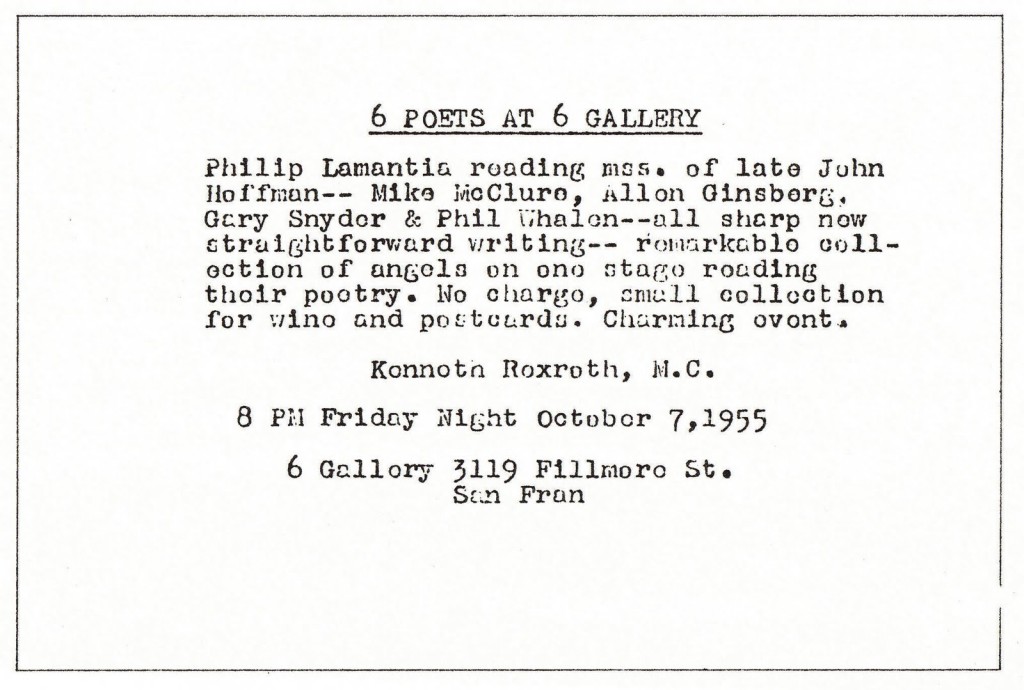
 While stationed with the U.S. Army in Germany during the 1950s, David Haselwood conceived the idea of becoming a publisher. At the time he was corresponding with his friend Michael McClure (also a native of Wichita, Kansas) who was living in San Francisco. McClure’s first book of poems, Passage (1956), was being published by Jonathan Williams’ Jargon Press. “Jonathan was having books printed in Germany because of the high quality and low cost,” Haselwood says, “and I began looking into things.”
 commercial printer (and edited by the printer without Haselwood’s knowledge), Haselwood was convinced that he should not only design all future books himself, but also print them: “The first and final consideration in printing poetry is the poetry itself. If the poems are great they create their own space, the publisher is just a midwife during the final operation…” With this ideal in mind, Haselwood tackled the publication of Philip Lamantia’s Ekstasis, and went on to the printing of Michael McClure’s Hymns to St. Geryon.
 mystical. According to Jack Foley in O Her Blackness Sparkles! The Life and Times of the Batman Art Gallery, 1960-65 (1995), the opening of the gallery was a “spectacular affair” and featured 99 pieces of Bruce Conner’s work. Auerhahn produced the announcement. In 1962, the gallery was sold to Michael Agron, a psychiatrist and University of California Medical Center associate professor who researched LSD as a therapeutic tool. Collaborating with Haselwood, Agron conceived of each exhibition’s announcement as a work of art. The first Agron show, Master-Bat, showcased the works of, among others, Conner and Branaman.
 Other collections soon followed, including McClure’s first major collection, HYMNS TO ST. GERYON AND OTHER POEMS (Auerhahn Press, 1958), THE NEW BOOK / A BOOK OF TORTURE (Grove Press, 1961), his powerfully erotic long poem DARK BROWN (Auerhahn Press, 1961), the wildly experimental “beast language” poems contained in GHOST TANTRAS (1964), and his vitriolic condemnation of the Vietnam War, POISONED WHEAT (Oyez, 1965). During these early years, McClure also took an active role in seeing that the words and ideas of other writers of the Beat movement and the Black Mountain School made it into print; he co-edited two influential literary journals of the period: ARK II / MOBY I and JOURNAL FOR THE PROTECTION OF ALL BEINGS.