
An eclectic periodical, published coincident with Tom Clark’s Fulbright study and posting as Instructor in American Poetry at the University of Essex. The titles varied but each was denoted “A One Shot Magazine… No Copyright No Nothin.”

An eclectic periodical, published coincident with Tom Clark’s Fulbright study and posting as Instructor in American Poetry at the University of Essex. The titles varied but each was denoted “A One Shot Magazine… No Copyright No Nothin.”
Edited by Tom Clark, the Once Series is an eclectic periodical, published coincident with Clark’s Fulbright study and posting as Instructor in American Poetry at the University of Essex. The titles varied (all words concluding with ‘CE’) but each was denoted “A One Shot Magazine… No Copyright No Nothin.”
According to Tom Clark: “When I went on from Cambridge to the U. of Essex in 1965 I began editing a mimeograph magazine of my own, the Once series, and through that project got into long-distance postal contact with many younger American poets, particularly those living on the Lower East Side of New York…
“The magazines had deliberately uncataloguable titles: Once, Twice, Thrice, Thrice and a Half, Frice, Vice, Ice, Nice, Slice, Slice Vol. 1, No. 2, and Spice. I filled up the mimeo series with the spillover of poems I was receiving for the Paris Review — which could handle only a fraction of the good new work that was coming in to me — as well as with some ‘assignments’ from friends far and near…
“Joe’s series of covers, a throwaway tour de force of periodical art, lent class, consistency and uniformity to the Once series, bringing a surprising illusion of orderly design to an otherwise rather undisciplined and chaotic enterprise.
“Most of the works I published in the Once series were somewhat or in some way more outlandish or strange than what I could cull for the Paris Review.”
1. ONCE: A One Shot Magazine, Vol. 1, No. 1, edited by Tom Clark
 Brightlingsea: Tom Clark, 1966
First edition, side-stapled in illustrated cover, 8″ x 13″, 14 leaves printed recto only, mimeograph printed.
2. TWICE: A One Shot Magazine, Vol. 1, No. 1, edited by Tom Clark
 Brightlingsea: Tom Clark, 1966
First edition, side-stapled in illustrated cover, 8″ x 13″, 7 leaves printed recto only, mimeograph printed.
3. THRICE: A One Shot Magazine, Vol. 1, No. 1, edited by Tom Clark
 Brightlingsea: Tom Clark, March 1966
First edition, side-stapled in illustrated cover, 8″ x 13″, 25 leaves printed recto only, mimeograph printed.
4. THRICE AND A HALF: A One Shot Magazine, Vol. 1, No. 1, edited by Tom Clark
 Brightlingsea: Tom Clark, 1966
First edition, side-stapled in illustrated cover, 8″ x 13″, 2 leaves printed recto only, mimeograph printed.
5. FRICE: A One Shot Magazine, Vol. 1, No. 1, edited by Tom Clark
 Brightlingsea: Tom Clark, April 1966
First edition, side-stapled in illustrated cover, 8″ x 13″, 24 leaves printed recto only, mimeograph printed. Cover art by Joe Brainard.
6. VICE: A One Shot Magazine, Vol. 1, No. 1, edited by Tom Clark
 Brightlingsea: Tom Clark, 1966
First edition, side-stapled in illustrated cover, 8″ x 13″, 27 leaves printed recto only, mimeograph printed. Cover art by Joe Brainard.
7. ICE: A One Shot Magazine, Vol. 1, No. 1, edited by Tom Clark
 Brightlingsea: Tom Clark, 1966
First edition, side-stapled in illustrated cover, 8″ x 13″, 20 leaves printed recto only, mimeograph printed.
8. NICE: A One Shot Magazine, Vol. 1, No. 1, edited by Tom Clark
 Brightlingsea: Tom Clark, 1966
First edition, side-stapled in illustrated cover, 8″ x 13″, 20 leaves printed recto only, mimeograph printed. Cover art by Joe Brainard.
9. SLICE: A One Shot Magazine, Vol. 1, No. 1, edited by Tom Clark
 Brightlingsea: Tom Clark, 1966
First edition, side-stapled in illustrated cover, 8″ x 13″, 26 leaves printed recto only, mimeograph printed. Cover art by Joe Brainard.
10. SLICE: A One Shot Magazine, Vol. 1, No. 2, edited by Tom Clark
 Brightlingsea: Tom Clark, 1967
First edition, side-stapled in illustrated cover, 8″ x 13″, 7 leaves printed recto only, mimeograph printed. Cover art by Joe Brainard.
11. SPICE, edited by Tom Clark
Brightlingsea: Tom Clark, 1967
First edition, side-stapled in illustrated cover, 8″ x 13″, 24 leaves printed recto only, mimeograph printed. Cover art by Joe Brainard.

Edited by Beat poet LeRoi Jones and Hettie Cohen, Yugen was devoted to “A New Consciousness in the Arts and Letters”. Bringing together the Beats, Black Mountain poets, and the New York School poets of the late 1950s, Yugen took its name from the Japanese aesthetic term meaning “a profound mysterious sense of the beauty of universe … and the sad beauty of human suffering.”
Edited by Beat poet LeRoi Jones and Hettie Cohen, Yugen was devoted to “A New Consciousness in the Arts and Letters”. Bringing together the Beats, Black Mountain poets, and the New York School poets of the late 1950s, Yugen took its name from the Japanese aesthetic term meaning “a profound mysterious sense of the beauty of universe … and the sad beauty of human suffering.” Cohen, later Hettie Jones, had worked at the Partisan Review and brought with her a background in little-magazine design that gave Yugen an air of respectability and professionalism. The contents represented a new and untraditional approach to poetry. Jones and Cohen also founded Totem Press, which published important early books by Gary Snyder, Philip Whalen, Allen Ginsberg, Michael McClure, Diane di Prima, Jack Kerouac, and many others. Like Yugen, Totem Press books typically feature calligraphic covers that mix American abstract expressionism and Japanese Zen painting.
1. YUGEN, No. 1, edited by LeRoi Jones and Hettie Cohen
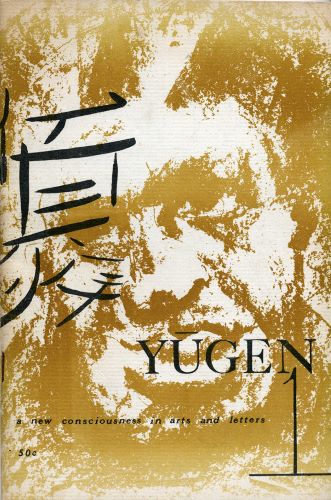 New York: Yugen, 1958
First edition, saddle-stapled in printed and illustrated wrappers, 5.5″ x 8.5″, 24 pages. Printed in New York by Troubador Press. Cover art by Peter Schwartzburg with calligraphy by Rachel Spitzer. Illustrations by Hector Stewart, Peter Schwartzburg, Tomi Ungerer, and Allen Ginsberg. Titles and composition by Rachel Spitzer and Michael Aleshire
2. YUGEN, No. 2, edited by LeRoi Jones and Hettie Cohen
 New York: Yugen, 1958
First edition, saddle-stapled in printed and illustrated wrappers, 5.5″ x 8.5″, 24 pages. Printed in New York by Troubador Press. Cover art and titles by Tomi Ungerer. Illustrations by Peter Schwarzburg.
3. YUGEN, No. 3, edited by LeRoi Jones and Hettie Cohen
New York: Yugen, 1958
First edition, saddle-stapled in printed and illustrated wrappers, 5.5″ x 8.5″, 24 pages. Cover art by Peter Schwartzburg. Illustrations by Stanley Fisher.
4. YUGEN, No. 4, edited by LeRoi Jones and Hettie Cohen
 New York: Yugen, 1958
First edition, saddle-stapled in printed and illustrated wrappers, 5.5″ x 8.5″, 28 pages. Cover art by Fielding Dawson.
5. YUGEN, No. 5, edited by LeRoi Jones and Hettie Cohen
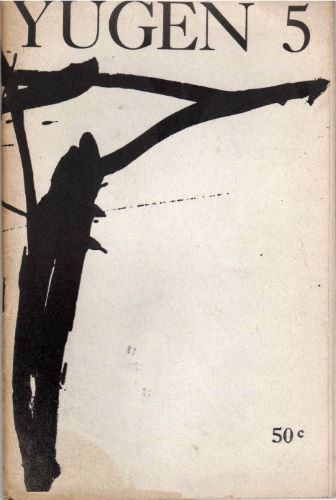 New York: Yugen, 1959
First edition, saddle-stapled in printed and illustrated wrappers, 5.5″ x 8.5″, 40 pages. Cover art by Basil King. Illustration by Fielding Dawson.
6. YUGEN, No. 6, edited by LeRoi Jones and Hettie Cohen
 New York: Yugen, 1960
First edition, saddle-stapled in printed and illustrated wrappers, 5.5″ x 8.5″, 52 pages. Cover art by Basil King.
7. YUGEN, No. 7, edited by LeRoi Jones and Hettie Cohen
 New York: Yugen, 1961
First edition, saddle-stapled in printed and illustrated wrappers, 5.5″ x 8.5″, 65 pages. Cover art by Norman Bluhm.
8. YUGEN, No. 8, edited by LeRoi Jones and Hettie Cohen-Jones
 New York: Totem Press, 1962
First edition, saddle-stapled in printed and illustrated wrappers, 5.5″ x 8.5″, 66 pages. Cover art by Basil King. Illustration by Aaron Roseman.
Online Resources:
· From a Secret Location – Yugen
· Reality Studio – Yugen

“Big Table was launched in Spring 1959 following the suppression of the Winter 1958 issue of The Chicago Review. An exposé in the Chicago Daily News revealed editors Irving Rosenthal’s and Paul Carroll’s plans to publish work by William S. Burroughs, Allen Ginsberg, Lawrence Ferlinghetti, and other Beat writers, and the administration quashed the magazine…”
“Big Table was launched in Spring 1959 following the suppression of the Winter 1958 issue of The Chicago Review. An exposé in the Chicago Daily News revealed editors Irving Rosenthal’s and Paul Carroll’s plans to publish work by William S. Burroughs, Allen Ginsberg, Lawrence Ferlinghetti, and other Beat writers, and the administration quashed the magazine.
Rosenthal and Carroll, along with other Chicago Review editors, resigned and with the suppressed material started Big Table. The first issue was edited by Rosenthal and Carroll, though Carroll had to withdraw his name in order to avoid being fired by Loyola University where he was employed. This issue contained work by Jack Kerouac (who named the magazine in a telegram: “CALL IT BIG TABLE”), Edward Dahlberg, and Burroughs (a section from Naked Lunch), and was summarily impounded by the US Post Office.
The lawsuit was unsuccessful and Big Table continued through 1960 and five issues. Rosenthal left the magazine after the first issue and Carroll stayed on as editor for the duration, publishing such writers and artists as Paul Bowles, Antonin Artaud, Leon Golub, John Logan, Robert Duncan, Denise Levertov, Robert Fulton, Harry Callahan, Douglas Woolf, Aaron Siskind, Paul Blackburn, Franz Kline, Diane di Prima, and Gregory Corso.”
— from A Secret Location on the Lower East Side
1. BIG TABLE, No. 1, edited by Irving Rosenthal and Paul Carroll
Chicago: Big Table, Spring 1959
First edition, sewn signatures bound in printed wrappers, 5.5″ x 8″, 158 pages, printed by The Profile Press of New York.
2. BIG TABLE, No. 2, edited by Paul Carroll
 Chicago: Big Table, Summer 1959
First edition, sewn signatures bound in printed and illustrated wrappers, 5.5″ x 8″, 124 pages. Cover art by Leon Golub.
3. BIG TABLE, Vol. 1, No. 3, edited by Paul Carroll
 Chicago: Big Table, 1959
First edition, sewn signatures bound in printed and photo-illustrated wrappers, 5.5″ x 8″, 120 pages. Cover photograph by Aaron Siskind.
4. BIG TABLE, Vol. 1, No. 4, edited by Paul Carroll
 Chicago: Big Table, Spring 1960
First edition, sewn signatures bound in printed and illustrated wrappers, 5.5″ x 8″, 144 pages. Cover art by Robert Fulton.
5. BIG TABLE, Vol. 2, No. 5, edited by Paul Carroll
 Chicago: Big Table, 1960
First edition, sewn signatures bound in printed and illustrated wrappers, 5.5″ x 8″, 128 pages. Cover art by Harry Callahan.
Online Resources:
From a Secret Location – Big Table
Reality Studio – Big Table
References Consulted:
Maynard, Joe and Barry Miles. William S. Burroughs: A Bibliography, 1953-73
Charlottesville: University Press of Virginia, 1978
While working at the Lewis Meyer bookstore on 37th and Peoria in 1959, Ron Padgett had an idea. Taken with the work of the era’s literary giants and New York-based “little mags” like the Evergreen Review, Padgett, barely 17 and still a junior at Central High School, decided that he would start his own avant-garde lit journal. He and his best friend Dick Gallup would be co-editors.
By high school, they were hanging out at Lewis Meyer Bookstore so often that Meyer offered Padgett a job. In addition to introducing the boys to a slew of edgy, contemporary authors, the store owner gave Padgett his first glimpse of what would lay the foundation for his concept: those avant-garde journals like Evergreen, Yugen, and Semina that contained short-form work from the same Beat and Black Mountain writers he was then devouring.
With two enthusiastic editors, the ambitious concept was becoming a reality. The next step was to recruit art editors. Padgett recruited classmate Joe Brainard as the journal’s art editor. They then invited Michael Marsh, a classical pianist who introduced the growing team to the work of Debussy and Capote, to be Brainard’s co-editor.
They called their magazine the White Dove Review, an homage to Evergreen, which featured on the cover of its sixth issue a striking black and white photograph of a young Asian woman holding a white dove. To fund its publication, they enlisted the help of Padgett’s mother, who donated $20 of the first issue’s $90 production cost. To typeset the journal, they borrowed the state-of-the-art IBM Presidential from their good friend and fellow classmate George Kaiser, who, Padgett said, “provided moral support for the magazine.”
They had their own poems, their own artwork, their own typewriter, and their own start-up funds. But then the White Dove editorial board took a bold step. Padgett and Gallup decided to fill the White Dove’s pages with the work they solicited from their heroes.
“Dick and I made a list of the living writers we were excited by,” Padgett explained. “Kerouac, Ginsberg, e.e. cummings, Malcolm Cowley, Paul Blackburn, etc. Then we wrote to them, care of their publishers, asking—begging, really—them for material. Our letter was rather immature, but in it we did confess to being in high school.”
According to Padgett, “a surprising number of writers responded” to the solicitations, and with the submitted work he and Gallup were able to choose what best fit their vision. The crown jewel of the premiere issue is Jack Kerouac’s “The Thrashing Doves,” a poem submitted by the Beat godfather as a knowing salute to the Review’s avian imagery:
“The thrashing doves in the dark, white fear,
my eyes reflect that liquidly
and I no understand Buddha-fear?
awakener’s fear? So I give warnings
‘bout midnight round about midnight
“And tell all the children the little otay
story of magic, multiple madness, maya
otay, magic trees- sitters and little girl
bitters, and littlest lil brothers
in crib made of clay (blue in the moon).
“For the doves.”
[excerpted from Joshua Kline’s essay on The White Dove Review]
1. THE WHITE DOVE REVIEW, Vol. 1, No. 1, edited by Ron Padgett, Richard Gallup, Joe Brainard, and Michael Marsh
 Tulsa: White Dove Review, 1959
First edition, saddle-stapled in printed and illustrated wrappers, 5.5” x 8.5”, 16 pages.
2. WHITE DOVE REVIEW, Vol. 1, No. 2, edited by Ron Padgett, Richard Gallup, Joe Brainard, and Michael Marsh
 Tulsa: The White Dove Review, 1959
First edition, saddle-stapled in printed and illustrated wrappers, 5.5” x 8.5”, 16 pages. Cover design by Michael Marsh.
3. WHITE DOVE REVIEW, Vol. 1, No. 3, edited by Ron Padgett, Joe Brainard, and Betty Kennedy
 Tulsa: The White Dove Review, 1959
First edition, saddle-stapled in photo-illustrated wrappers, 5.5” x 8.5”, 20 pages. Cover photograph of Chrissie Bartholic by John Kennedy.
4. WHITE DOVE REVIEW, Vol. 2, No. 4, edited by Ron Padgett, Joe Brainard, and Betty Kennedy
 Tulsa: The White Dove Review, 1960
First edition, saddle-stapled in photo-illustrated wrappers, 5.5” x 8.5”, 16 pages. Cover design by Joe Brainard.
5. WHITE DOVE REVIEW, Vol. 2, No. 5, edited by Ron Padgett, Joe Brainard, and Betty Kennedy
 Tulsa: The White Dove Review, 1960
First edition, saddle-stapled in photo-illustrated wrappers, 5.5” x 8.5”, 24 pages. Cover by Joe Brainard.
Online Resources:
Granary Books – The White Dove Review
—

While working at the Lewis Meyer bookstore on 37th and Peoria in 1959, Ron Padgett had an idea. Taken with the work of the era’s literary giants and New York-based “little mags” like the Evergreen Review, Padgett, barely 17 and still a junior at Central High School, decided that he would start his own avant-garde lit journal. He and his best friend Dick Gallup would be co-editors…

In the Fall of 1961, Jon and Louise “Gypsy Lou” Webb published the first issue of their avant-garde poetry and prose magazine, The Outsider. Handset and letterpress printed, the journal straddled the line between traditional books and modern works of art, and the journal made an outsized impact on the literary world, shining a light on the talents of Beat Generation, Black Mountain and other avant-garde and counterculture poets, writers, and artists of the era.
In all, Loujon Press published three issues of The Outsider (one a double issue), and two books each by poet Charles Bukowski and novelist Henry Miller. These publications received at least as much praise for their quality as physical artifacts as they did for the poems and prose that made up their editorial matter. It seems like a small catalogue, but the remarkable artistry, craftsmanship, and pioneering spirit have earned the press a much larger place in history.
As art writer Nathan Martin commented, “Loujon operated during a particular moment in the history of artistic publishing in America … and remains a distinctive and compelling entity at the intersection of fine-press publishing, counterculture literature, and the French Quarter from which it emerged.”
Loujon Press Checklist:
1. The Outsider, Vol. 1, No. 1, edited by Jon Edgar Webb
 New Orleans: Loujon Press, Fall 1961
First edition, side-stapled and bound into printed and photo-illustrated wrappers, 6” x 9”, 101 pages, 3100 copies, letterpress printed with handset type on a C&P handpress by Jon and Louise Webb. Associate Editor: Louise “Gypsy Lou” Webb; Advisory Editors: Marvin Bell, Margaret Randall, Jory Sherman, Edwin Morgan, Melville Hardiment, Sinclair Beiles; Consultant: Walter Lowenfels; illustrations: F. Salantrie.
2. The Outsider, Vol. 1, No. 2, edited by Jon Edgar Webb
 New Orleans: Loujon Press, Summer 1962
First edition, side-stapled and bound into printed and photo-illustrated wrappers, 6” x 9”, 112 pages, 3100 copies, letterpress printed on a 8″ x 12″ C&P new series motorized press by Jon and Louise Webb. Associate Editor: Louise “Gypsy Lou” Webb; illustrations: Ben Tibbs, Frank Salantrie, Malcolm Paul Newman.
3. The Outsider, Volume 1, Number 3, edited by Jon Edgar Webb
 New Orleans: Loujon Press, Spring 1963
First edition, side-stapled and bound into printed and photo-illustrated wrappers, 6” x 9”, 138 pages, 2100 copies, letterpress printed by Jon and Louise Webb. . Associate Editor: Louise “Gypsy Lou” Webb; illustrations: Jackson Hensley, Ben Tibbs, Frank Salantrie.
4. Bukowski, Charles. It Catches My Heart In Its Hands / New & Selected Poems 1955-1963
 New Orleans: Loujon Press, October 1963
First edition, sewn signatures in printed wraparound jacket, designed and printed by Jon Edgar Webb and Louise Webb, introduction by William Corrington, illustration by Frank Salantrie, dedicated to “Gypsy Lou” Webb, 7.5” x 10”, 102 pages, 777 copies, letterpress printed, published as Gypsy Lou Series #1.
(Dorbin A5)
5. Bukowski, Charles. Crucifix In A Deathhand / New Poems 1963-65
 New York: Lyle Stuart, April 1965
First edition, sewn signatures in printed wraparound jacket, designed and printed by Jon Edgar Webb and Louise Webb, etchings by Noel Rockmore, dedicated to Marina Louise Bukowski, 8.5” x 12.25”, 102 pages, 3100 copies, letterpress printed, published as Gypsy Lou Series #2.
(Dorbin A6)
6. Miller, Henry. Order And Chaos Chez Hans Reichel
 Tucson: Loujon Press, December 1966
First edition, perfect bound in printed wraparound jacket in printed slipcase, leather editions bound by the Schuberth Bookbindery of San Francisco, introductory statement by Karl Shapiro, introduction by Lawrence Durrell, photograph of Miller by Ina Paulandre tipped in, 9” x 9.75”, 87 pages, 1425 copies, letterpress printed, published as Gypsy Lou Series #3.
(Shifreen & Jackson A157a-g)
7. The Outsider, Vol. 2, No. 4/5, edited by Jon Edgar Webb
 New Orleans: Loujon Press, Winter 1968-69
First edition, issued in both wrappers and hardcover in printed dust-wrapper and photo-illustrated paper wrappers, 7.25” x 10.25”, 200 pages, 500 copies. Associate Editor: Louise “Gypsy Lou” Webb, illustrations: Ben Tibbs, Frank Salantrie, Kelsie Harder. Laid into this edition is “a sprig of flora from within a mile of Geronimo’s grave”, picked by Gypsy Lou and sealed in wax paper with letterpress printed partial wrap-around band.
8. Miller, Henry. INSOMNIA OR THE DEVIL AT LARGE
 Albuquerque, Loujon Press, 1970
First edition, portfolio case with photo-illustrated sliding lid and housing 12 printed reproductions of Miller watercolors and a spiral bound book, 7 separate issues planned but far fewer were reportedly produced, published as Gypsy Lou Series #4.
(Shifreen & Jackson A175a-h)
Notes:
[1] Though not present in Robert Wilson’s Corso bibliography, this offprint has been examined.
[2] According to a Ken Lopez catalog entry, his copy of the Miller offprint is seven unbound leaves printed on both sides from volumes 1 and 2 of The Outsider and published in a set of 200 in 1963. However, Shifreen & Jackson describe the sets as 13 unbound leaves printed on rectos only.
[3] Listed in Michael McClure’s own online bibliography and confirmed by Denise Enck of Empty Mirror Books, though not present in any printed bibliography to date.
[4] First reference to the Burroughs offprints appear in Jon Edgar Webb: The Editor’s Bit and Obit by Nicky Drumbolis and are further discussed in Signatures, also by Nicky Drumbolis. Subsequent research turns up no extant copies and in later correspondence with Drumbolis, he adds, “In my Signatures study, I infer that the Burroughs piece ‘Operation Soft Machine/Cut’ may have been issued, based on layout; acknowledging further, that no copy had been recorded by Maynard and Miles.”
[5] While the existence of this offprint and another containing the full set of Miller letters from the first 3 issues of The Outsider are noted in Jon Edgar Webb: The Editor’s Bit and Obit, no evidence of these offprints has been identified.
References consulted
Dorbin, Sanford. A Bibliography of Charles Bukowski
Los Angeles: Black Sparrow Press, 1969
Drumbolis, Nicky. Jon Edgar Webb: The Editor’s Bit & Obit
Toronto: ECS, 1993
Drumbolis, Nicky. Signatures
Toronto: Letters, n.d.
Krumhansl, Aaron. A Descriptive Bibliography of The Primary Publications of Charles Bukowski
Santa Rosa: Black Sparrow Press, 1999
Maynard, Joe and Barry Miles. William S. Burroughs: A Bibliography, 1953-73
Charlottesville: University Press of Virginia, 1978
Shifreen, Lawrence J. and Roger Jackson. Henry Miller: A Bibliography of Primary Sources
Ann Arbor: Roger Jackson, 1993
Wilson, Robert. A Bibliography of Works By Gregory Corso 1954-1965
New York: The Phoenix Bookshop, 1966

In the Fall of 1961, Jon and Louise “Gypsy Lou” Webb published the first issue of their avant-garde poetry and prose magazine, The Outsider. Hand-set and letterpress printed, the journal straddled the line between traditional books and modern works of art, and the journal made an outsized impact on the literary world, shining a light on the talents of Beat Generation, Black Mountain and other avant-garde and counterculture poets, writers, and artists of the era…